Thursday, April 29, 2010

Woman Warrior 3

It is truly very difficult for me to understand Brave Orchid and her cruel actions towards her daughter. Here is a woman who has undergone incredible hardship, left her culture and her country for a completely new one, raised a family, cared for her naïve and eventually ailing sister, and done all of this quite effectively. She is, in so many ways, a hero and someone any young woman should look up to.

Every once in a while, we even get to see the kind, loving side of Brave Orchid. I was particularly struck by how sweetly Brave Orchid cared for Moon Orchid just before she was placed in the mental asylum. She is incredibly patient with Moon Orchid as her sister begins to lose her mind. Kingston writes, “Moon Orchid had misplaced herself, her spirit scattered all over the world. Brave Orchid held her sister’s head as she pulled on her earlobe. She would make it up to her,” (Woman Warrior, 157). She listens to Moon Orchid’s stories of delusions and does her best to bring her back to the world of reality by, “tweak[ing] her sister’s ears for hours, chanting her new address to her, telling her how much she loved her and how much her daughter and nephews and nieces loved her, and her brother in law loved her,” (Woman Warrior, 156). She eventually has to place Moon Orchid in a mental institution because of her children as, “their aunt was saying terrible things when they needed blessing,” (Woman Warrior, 159). But her love for her sister was apparent even in that action, and it was clear that she would do just about anything for her. (It cannot be fun to send your own sister to a creepy insane asylum like this, but Brave Orchid knew what was best for her sister and loved her enough to do so, no matter how painful it was for her. This is another example of that tough love Brave Orchid was so familiar with. image courtesy of:http://theresalduncan.typepad.com/witostaircase/images/insane_asylum_1.jpg). Which is why I am so confused when it comes to the relationship between Brave Orchid and Kingston. Kingston clearly recognizes these moments of kindness, comfort, and love between her mother and her aunt, especially that which is coming from her mother. And yet, Kingston seems to recall mostly the painful incidents – the arguments, the disagreements, the old wounds – between she and her mother. What comes to mind in terms of painful arguments is the part of the novel where Kingston discusses her word vomit (as I like to call it) when she completely unleashes all her feelings and pain from her life onto her mother. Kingston screamed to her mother that she couldn’t tell when her mother was telling the truth and when she was lying, that she was not a good role model, that Kingston herself was not happy at Chinese school where her mother insisted she be. And, instead of responding by taking pause, considering what her daughter was saying, acting how she might if Moon Orchid were telling her something, Brave Orchid responds with, “You’re still stupid. You can’t listen right. Can’t you take a joke? You can’t even tell a joke from real life. You’re not so smart. Can’t even tell real from false,” (Woman Warrior, 202). The conversation continues until Brave Orchid tries to defend her calling her daughter ugly, saying that she would never say such a thing. Kingston’s response: “You say that all the time,” (Woman Warrior, 203).

However, I think that a small bit of redemption is made for Brave Orchid and Kingston’s relationship towards the end of their epic argument. Since Kingston decides to make the argument one filled with feelings and emotions and sentiments she has kept inside of her for her entire life, her mother finally decides to level with her. She finally decides to throw her daughter a bone, to level with her daughter, whatever you want to call it. Following Kingston’s accusation that Brave Orchid has always called her ugly, Brave Orchid says, “That’s what we’re supposed to say. That’s what Chinese say. We like to say the opposite,” (Woman Warrior, 203). Once I read this, I knew I didn’t have to read any further or examine the text any further to know one thing for certain: Brave Orchid loved her daughter very, very much. As much or more as she loved Moon Orchid. She simply was unable to show it due to ancient Chinese ways that she had grown up with.(Tough love, baby. That's what Brave Orchid was all about. image courtesy of:http://tough-love-jeans.co.uk/img/toughlove.png). Brave Orchid had left so much of her culture behind when she left China, she was obviously holding onto what little of her culture she had inside of her. Unfortunately, this resulted in Kinston thinking for for most of her life that she was worthless to her mother. I can only hope that through writing this novel, Kinston was able to heal. Hopefully, she was able to take every insult ever hurled at her by her mother, think of the opposite, and know that her mother really did love her. I hope that Kingston was able to forgive her. For, just as Brave Orchid said to her sister, so I believe she felt about her daughter, “I won’t let anything happen to you. Don’t be afraid,” (Woman Warrior, 156).

Tuesday, April 27, 2010

Woman Warrior 2

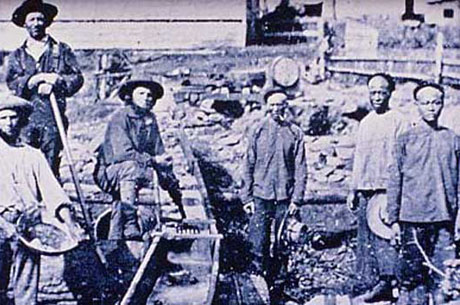
In this class we have paid a lot of attention to other cultures, religions, and ways of living. However, we have not given a lot of time – until the last couple of weeks – to the difficulties of immigrants living in America. I am studying this in my history class right now, as we learn about the immigration boom in America during the 19th century. Back then, people from China, Mexico, and other countries moved to America to pursue a better life for their families. Not for themselves. They were put to work on railroads, in factories, and at other jobs that involved unskilled labor.(image courtesy of: http://www.goldsea.com/AAD/Milestones/railroad.jpg). They were paid next to nothing and – because this was before any sort of labor laws or unions were in place – were outrageously overworked. Most of them, history has shown us through letters and novels, hated their lives in America, but stayed to give their children the opportunity to capitalize on being 1st generation Americans (as many immigrants gave birth to children once they had moved to the US). (I google-image searched the word "immigrant" and this is what I found. How can we expect immigrants to WANT to be here when we are the opposite of welcoming to them?! image courtesy of: http://latimesblogs.latimes.com/photos/uncategorized/2007/03/26/immigrant_rally.jpg). In many cases, their children did adjust extremely well and moved up in the workforce, eventually making great amounts of money and raising their own families. That is, of course, the story of why America is the land of opportunity and the great melting pot.

However, though I know the stories of the distant past through my history class, I had not stopped to consider that this struggle of the immigrant was still occurring during the 20th century setting of The Woman Warrior – or that it might still be happening today. When reading about Kingston’s mother, Brave Orchid. Kingston talks about how her mother and father both knew of the communist troubles their former home was undergoing and that it would not be safe or practical for them to return. Yet, Brave Orchid longs for her old friends, her old status as a doctor, and her old life. Said she, “This is terrible ghost country, where a human being works her life away. In China I never had to even hang up my old clothes. I shouldn’t have left,” (Woman Warrior, 104). Her daughter attempts to reason with her, saying “If you hadn’t left, there wouldn’t be a me for you to support, Mama,” (Woman Warrior, 104). Still, Brave orchid complains about the pace of life in America, saying “Human beings don’t work like this in China. Life goes slower there,” (Woman Warrior, 104) and insists on labeling every white person she sees as a “ghost” of some form. Yet, though she complains of the faced-pace days in America, she has done a better job adjusting than perhaps she even knows, as she is able to work and do a lot of household jobs while her sister, Moon Orchid, newly immigrated from China, can do very little. Kingston even describes how Brave Orchid grows impatient with Moon Orchid’s inability to do even little tasks in a timely manner and, Kingston notes that eventually Brave Orchid gets so frustrated she says, “’Go take a walk!” and Kingston describes her as “exasperated,” (Woman Warrior, 137). Her daughter, on the other hand, considers America to be where she belongs, which one would think would be what Brave Orchid desired for her family. Instead, she continue to bemoan her situation and wish for her life back home. This is understandable, to me, but still heartbreaking. I cannot imagine giving up my entire life to come to another country where I would be completely unhappy. I cannot imagine my own country becoming so dangerous that I had to leave. I cannot imagine giving up everything I love for my children – and then not valuing my little girl because she was a girl. But that’s just that: I cannot imagine it. So I cannot judge Brave Orchid on her decisions or attitude or the way she makes her daughter feel, I can only take notice of the way she handles things and try to learn more about what made Brave Orchid the way she was and how that shaped Kingston’s life and memories.

Thursday, April 22, 2010

Woman Warrior 1

I am all about Woman Warrior right now. As soon as I opened this book and read the opening line from Kingston’s mother to a young Kingston, “You must not tell anyone what I am about to tell you,” I was enraptured by this biography/memoir/novel/masterpiece (Woman Warrior, 3). Of course, since Kingston proceeds to tell all of her readers exactly what her mother tells her, it is an extremely powerful and ironic first sentence of a story that is all about breaking the rules. Kingston, I quickly realized after picking up the book, is the woman warrior she names her book after. (I find myself in awe of Maxine Hong Kinston and her life. image courtesy of:http://latimesblogs.latimes.com/photos/uncategorized/2008/04/27/hong.jpg).

I feel a special kinship to Kingston. Though my situation was nowhere near as dire as her own, I can relate to her suffering of being of the unwanted sex in her family and culture and her actions of make-believe in a small way. My grandmother had a very sad life. She suffered from bipolar disorder and alcoholism and was a woman, on top of all that, who was very set in her ways. Her children don’t talk much about it but I can sense that life at home with their mother was not something they look back upon fondly. My father (her son) was supposedly the golden child because he was the only boy out of 4 children – and my grandmother wanted only boys. Something about the importance of the last name passing on, for antiquated reasons similar to that of the Chinese culture Kingston grew up amidst – made my grandmother say something to my mother (her daughter-in-law) just after she gave birth to me that has always stuck with my mom. I was 7 pounds 0 ounces lying in my mother’s cradled arms and my grandmother looked down at me then back up at my mother and said, “I’m sorry it wasn’t a boy. Hopefully next time.”How can you look at a little baby - especially one as cute as me ha ha - and say something like that? Luckily for me, my parents never once bought into the ideology that "boys are better".(My dad holding me as a baby. image is author's own.) Naturally when my brother was born two years later, she was overjoyed. Holidays were pretty much the only times I saw my grandmother but those were painful on their own. My brother would receive kisses and laughter and gifts like a massive train set that spanned the entire house while I – desperate for some of my grandmother’s attention – would only be noticed by her if it involved some kind of scolding for eating all the caviar and my gifts would include a used paperback book. It sounds crazy, but that’s how it was. I think she loved me, but I think that her mental disorder and her old fashioned beliefs of right and wrong got in the way of her being able to show me.(I did not feel loved by my grandmother, but I think that deep down she loved me. image is author's own.) Kingston feels the same sentiment when she explains, “from afar I can believe my family loves me fundamentally. They only say ‘when fishing for treasures in the flood, be careful not to pull in girls’,

“ (Woman Warrior, 52). In this sense, I was luckier than Kingston, who had to deal with rejection all around her based on being a girl and not just from one person. She says, “I read in an anthropology book that Chinese say, ‘girls are necessary too’; I have never heard the Chinese I know make this concession,” (Woman Warrior, 53).

To escape from that, I sometimes played what my mother called my “imaginary games” where I would run all over the backyard pretending to be someone else. Some days I was a basketball star, other times I was a strong female character from a Disney movie like Mulan. When I read that Kingston imagined herself as Fa Mu Lan “the girl who took her father’s place in battle” I was amazed that we had both resorted to the same fantasies about ourselves to give us strength (Woman Warrior, 20).(I used to pretend to be the Disney version of Fa Mu Lan - a strong woman warrior herself. image courtesy of:http://www.uweb.ucsb.edu/~courtney_hendrickson/mulan8.jpg). Both of us refused to see ourselves – even in our fantasies – as anything less than a strong, powerful woman. Regardless of what those around us wanted us to be. I am proud of young Kingston and her refusal to roll over and assume that she should believe what her family and culture tells her about being a girl. I am excited to continue reading and see what other stands she takes in her life against injustice.

Tuesday, April 20, 2010

It matter and it doesn't.

“Race matters. And it doesn’t” (Course Anthology, 866). So says the quote from Anthony R. Luckett in his personal story of growing up as an Asian American student and foster child in America. When reading through his story and the story of others, like Johnny Lee, I decided to make another perhaps bold statement of my own: Sexual orientation matters. And it doesn’t. Lee tells his own story in “No Such Thing” detailing the pain he had from hiding his homosexuality from everyone around him – including his mother – and how difficult it all was for him. “Back then I did not tell anyone what I was going through because I did not want to be seen as evil.” (Course Anthology, 869). He turned to internet chat rooms which, “became an amazingly refreshing release for [him]. For the first time [he] found a way to talk to other people like [himself],” (Course Anthology, 870). He also found himself at a crossroads with his decision to keep his sexuality hidden when he ended up at a man from the chat rooms’ house nearly getting raped and murdered. At that point, he realized something: “hiding my homosexuality from the world was only going to bring me grief,” (Course Anthology, 872). After he ends up remorsefully admitting to his mother that he is gay, he explains that “I became overwhelmed by a combined sense of relief from having shared this enormous secret and regret for allowing those words to escape from me,” (Course Anthology, 872). His mother’s response? “I don’t believe….I don’t believe….No such thing as the gay Korean. You are lying. There is no Korean gay…” (Course Anthology, 873).

Up until taking this class, I thought my Iife was pretty hard. I was not the smartest in my class – or anywhere near – at a highly competitive high school where grades are analogous to your self worth and got a lot of grief about that from both my parents and my classmates. I was a good swimmer but I suffered from a back injury that forced me – so I thought at the time – out of the sport completely. My brother has all kinds of behavioral problems that make family holidays like Christmas a really upsetting thing. But after taking this class and reading accounts like Johnny Lee’s I have to understand that I have NO idea what “hard” actually is. The truth is, I have lived a relatively charmed, cushy life. I have a few problems, who doesn’t? But I have never had to harbor a secret like Johnny Lee. The kicker of Johnny’s secret is that he is not hiding something he did wrong, nor is he even hiding something he DID at all. He is hiding something that he was born with, like an ugly birthmark or something.(Like a birthmark, Lee's sexuality was something that he could not control but felt he had to be ashamed of. image courtesy of:http://www.makeupsfx.co.uk/products/davysil/davysil_images/birth_mark_02_big.jpg).That his mother decides to bring race into the equation when she tells him that he simply cannot be a gay Korean is something I can barely comprehend, it is so painful. Vincent Ng aptly sums up the combination when he explains that, “The deeper friendships I began to form led to more honest self-disclosure, and I really began to question what it meant to be both a Chinese Canadian male and a sexual being,” (Course Anthology, 884). I personally don’t know the answer to that question, but then again I had never even considered that it would be a question – for I myself as a straight, white individual have never had to deal with the rejection and pain not just of struggling with my sexuality but of reconciling it with my race and culture and lineage – something that is especially important, I have come to understand, in Asian races.

Race matters. Sexual Orientation matters. And yet they don’t. I don’t mean to go all groovy 1960’s on everybody, but so many of these young men’s problems could have been solved if their parents had just LOVED them and not judged them.(Image courtesy of: https://blogger.googleusercontent.com/img/b/R29vZ2xl/AVvXsEggvRI3LOORmO7rces-xqRgYYpQBO6OwGjNZJuxT4jPE1u8Ly0sv78i_w21OcAO1MftCBC_RCetp6mi8165qfRhd3_eAdmPZve2saurZex5Ioe77z8smyHQF5CQyOMRFetS43RyblJt_ks/s1600/hate-crimes-stop-hating.jpg). Each of these men realized that once they came out of the closet or accepted themselves for their race or sexuality or both, life got a lot easier. They realized that neither quality had to define them. I have a great deal of admiration for the individuals I read about tonight and am grateful they decided to take a stand to tell their stories – not just for the gay youth that will hopefully gain strength from them, but for people like me who never comprehended the difficulties of the combination of race AND sexual orientation.

Thursday, April 15, 2010

Inspired

I have to say that in reading the three stories of diversity assigned to us, I felt myself become more and more inspired as I read each of them. Especially inspiring was the story of Allesandro Melendez’s life growing up as a Puerto Rican living in Connecticut attending a difficult and exclusive prep school.

The description of the school reminded me to my high school.(A prep school can be a very intimidating thing for anyone, like mine, shown above. image courtesy of:http://www.boardingschoolreview.com/photos/large_2_54.jpg). Melendez explains that Lewisberg prep school was a, “predominantly white and wealthy environment,” (Course Anthology, 857) which was the case with my high school as well. My school also had day students and boarding students, just as his did. So naturally, I began to picture myself back at my school, traveling through each year of high school just as Melendez did. I began freshman year as a new student at my prep school and felt, just as Melendez did, that “prep school was a whole new world for me,” (Course Anthology, 855). I was completely out of my element and terrified, just like Melendez who began to feel that, “I just don’t belong in this place, everyone here is smarter than I am,” (Course Anthology, 855). I felt the exact same way, but as I read this book today I realize that Melendez had one extra fear: “They’ll just laugh at me if I speak in my Spanish accent,” (Course Anthology, 855). That’s when my respect for Melendez began to grow. As I flipped through my years of high school in my mind I thought of the all-nighters I had pulled, the math problems I had struggled over, the science experiments I had performed in my backyard. Then I took the stress and the difficulty of that work and multiplied it by about ten, and I think I accurately understood what Melendez was going through. I honestly cannot imagine attending an entirely new and difficult school while still struggling with English, with being the only member of your family able to be “handl[ling] all the financial, academic, and commuting arrangements,” (Course Anthology, 853). The thought is both terrifying and exhilarating – terrifying because I don’t know that I could ever juggle so much and exhilarating at the thought that maybe I actually could. I would imagine that was probably close to how Melendez felt.

Allesandro Melendez could have failed out of his prep school. He could have worked just as hard as he needed to – as I was sometimes guilty of in high school – or he could have abandoned his racial pride entirely in order to please the white community around him and become “one of them”. Miguel Ramirez could have conceded to defeat when he realized, as he said "the United States was home, but it wasn't mine," (Course Anthology, 837). Norma Andrade could have given up hope when she was forced to take on cleaning jobs that "society [had] taught [her] to respect the jobs of lawyer, doctor, and professor and to look down on the kind of work [her] mother did," (Course Anthology, 848). Instead, Allesandro managed to work as hard as possible to make good grades and become the best while still holding onto his identity as a Puerto Rican.Ramirez and Andrede both put aside their own stereotypes and prejudices that were limiting their successes and eventually became more successful than they could have been in their wildest dreams.(Melendez can call himself both a Puerto Rican AND an American. image courtesy of:http://mentalfloss.cachefly.net/wp-content/uploads/2008/05/puerto-rico-flag.jpg). It’s stories like his that make us realize just how difficult the life of an immigrant can be and also just how important his efforts are not only for Puerto Ricans but for all races – white included – who can become inspired by his work ethic, determination, and pride.(ALL races. image courtesy of:http://blogs.freshminds.co.uk/talent/wp-content/uploads/2009/03/diversity02_transparent.gif).

Tuesday, April 13, 2010

The Bluest Eye 3

Writing, I have come to realize through this class and especially through my reading of Toni Morrison’s the Bluest Eye, is truly a universal language. It allows us to put our feelings to paper in a way that is more satisfying than talking to oneself and yet also just as private. It gives me personally an outlet for my feelings that I utilize not only because, as I always say to my friends, “I’m better on paper than in person”, but also due to the fact that writing is permanent. That permanent aspect can give us the advantage of perspective which, in turn, helps us find our way in terms of not making the same mistakes over and over again. Writing becomes like history that way.

Morrison’s work, I realized, is not only her outlet for recording past memories and experiences – it is a way for her to get answers to questions she has had for a long time. She explains in the afterward of the novel that she once had an experience with a beautiful African American friend who claimed to want blue eyes more than anything in the world. “The Bluest Eye was my effort to say something about that; to say something about why she had not, or possibly ever would have, the experience she possessed and also why she prayed for so radical an altercation,” (Morrison, 210). Decades later, Morrison was left with so many questions about the young girl and the racial, social, and physical barriers that caused her to feel such a way. “Who made her feel that it was better to be a freak than what she was?” Morrison questions (Morrison, 210). Writing this novel was not only Morrison’s way of searching for these questions within herself, it also served as an education for any and all readers with self-esteem problems stemming from race or beauty or any combination thereof. (Blue eyes; coveted. image courtesy of:http://theaterboy.typepad.com/theaterboy/Bluest%20Eye%20%232.5.jpg).

I figured I could cover the “basic” topics for this DB. Talk more about why Morrison wrote the Bluest Eye or ask myself more about race and beauty. Don’t get me wrong, those are important topics. But what stuck with me the most after finishing this novel was how a writing choice Morrison made in the novel affected my entire view of a man, a family, and a race of people. In one of the later chapters of the book, the story of Cholly Breedlove is told in full. His life as a boy with a beloved Aunt who died when he was young is detailed, as is his horrific experience as a victim of two white men who force him to continue to have sex with a young woman as they watch. As we all know, the book come to a near close with Cholly raping Pecola. If someone had told me the summary of this book – leaving out Cholly’s family history told from his point of view – I would have been completely disgusted at his rape of the little girl. I probably would have been disgusted to the point that I would write Cholly off as an insane man. However, Morrison made a choice when writing about Cholly’s life story and the rape of Pecola to tell it from his perspective, as opposed to Pecola’s. Instead of describing Pecola’s feelings during the rape, Morrison writes, “The sequence of his emotions was revulsion, guilt, pity, then love. His revulsion was a reaction to her young, helpless, hopeless presence,” (Morrison, 161). Of course we know that the rape is a terrifying event for Pecola, but I would never have guessed how confusing it was for Cholly – a man whose brain and soul are completely backwards and skewed thanks to the white men who ruined his life with their despicable actions. “Whether her grip was from a hopeless but stubborn struggle to be free, or from some other emotion, he could not tell,” notes Morrison of his confusion, (Morrison, 163).(image courtesy of:https://eee.uci.edu/programs/humcore/Student/Fall2009/LectureNotes/week10/Toni-Morrison-abstract-image-Pecola.jpg). I of course am not condoning Cholly’s actions or calling them anything other than despicable, but I do think it is important to note that thanks to Morrison’s writing decision, the story takes on new meaning and helps me as a reader realize just how deep racism can go and just what kind of affect it can have on people for the rest of their lives just as it did with Cholly.

Monday, April 5, 2010

The Bluest Eye 2

One thing I have learned in reading Toni Morrison’s The Bluest Eye is how little I truly knew of the details of racism prior to reading this book. Of course I understood the concept – but having grown up in a relatively sheltered community with a very open-minded family surrounding me, I have never had the experience of witnessing racism directed at any particular person or group. Nor have I had it inflicted upon me. Morrison is incredibly gifted not only at telling one of a billion stories of racism clearly and effectively, she is able to do so in a way that people like me – with little firsthand experience regarding the subject – are able to not only grasp the deeper meaning of the story but can actually put themselves in the shoes of the characters in the novel.(image courtesy of:http://www.lemel.co.il/global/racism.jpg).As professor Bump himself notes in his article on race and appearance in the Bluest Eye, “I would suggest that ultimately [the thing] is judging by appearance, and that Morrison focuses on ugliness to enable white readers to feel something of what it is like to be judged by racial hierarchies of skin color and the master and family narratives that reinforce them,” (Course Anthology, 332).Essentially, as a result of Morrison’s writing and storytelling talent, I find myself feeling the pain of each of the characters uniquely; not a fun experience, but probably a necessary one for me.

Particularly, I find myself feeling for Claudia and Pecola, especially when it comes to their self-esteem, which seems to be continually brought to a lower level with each “life experience” they undergo. Last class I wrote about Claudia’s hatred for a white doll she received as a gift and about how her intense hatred for and jealousy of the doll drove her to destroy it.(Claudia HATED her little white doll - for many reasons that later bled into her real life with real white individuals and "whiter" African American girls like Maureen . image courtesy of:https://blogger.googleusercontent.com/img/b/R29vZ2xl/AVvXsEgjLfz83V1vwO6b5sZuckfh8TL35EEYNRpNpcFc7QVYsFAJqPlYQnt_kswhItw3uPHddFxfS2bFUf037-VmBF77KCcTKXGNz1EQN4xXXLzYgoH13KpWfCOHqbsrcN4oDY-eWOFn3cgIghM/s320/Bluest+Eye+Web+Image.jpg). So, when I read about Claudia and Pecola’s interactions with Maureen Peal – the lighter skinned African American student whom the girls were both mystified by and jealous of. Though they get along originally, Maureen’s constant questioning of the girls eventually leads to a full-scale argument, where Maureen ends up shouting at the girls, “I am cute! And you ugly! Black and ugly black e mos! I am cute!” (Morrison, 73). When I read this, I admit I was surprised. Ignorantly, I had never understood the concept of racism within a single race. Now I see that not only does it exist, it is probably more painful than racism coming from an outside race. I could almost feel Pecola’s pain, which Claudia describes in this way: “[Pecola] seemed to fold in on herself, like a pleated wing,” (Morrison, 73). I finally understood the line from earlier in the chapter about Maureen, that she was “someone who splintered the knot into silver threads that tangled us, netted us,” (Morrison, 62). For someone of their own race to make fun of Pecola and Claudia for being “too black” must have hurt doubly because it was as if one of their own had turned on them – effectively splintering that aforementioned knot.

Another part of Maureen, Claudia, and Pecola’s conversation that affected me the most and truly saddened me occurred after Maureen yelled insults at the girls. Claudia at one point muses, “we were sinking under the wisdom, accuracy, and relevance of Maureen’s last words. If she was cute – and if anything we believed she was – then we were not,” (Morrison, 74). "Many emotions, including shame, are generated by comparing someone with an ideal, making them seem less than, inferior, a mistake," notes Professor Bump (Course Anthology, 332). I can honestly say that Pecola's pain in this instance and Claudia's plummeting self-esteem was painful for me to read. Just because some girl decided to spew pointless racial stigmas and insults to get a rise out of these girls, Claudia and Pecola will be mentally and emotionally damaged forever. Not fair isn't strong enough to describe this.

I know that the day after tomorrow I will again crack open this book and begin to read more of the struggles of Pecola and Claudia just to survive. I know that it will be painful. But I also know that because Morrison is talented enough to make someone as naive, innocent, and sometimes plain-old ignorant as me feel this pain, I will benefit from learning about this time in our history. If for no other reason than to make absolutely certain that I do not allow history to repeat itself.

Thursday, April 1, 2010

The Bluest Eye 1

Toni Morrison’s The Bluest Eye is – thus far in my reading – not an easy story to swallow. It details poverty, abuse, racism, and other such tragic themes. When I learned what the book was about, I figured I would probably write a blog entry about family – about learning to live with all types of personalities in one family, or possibly about family sticking together through thick and then. Then I read the book. It is true, what Professor Bump says about the new “typical” family story: “From the perspective of family systems therapy, the motivation for narrative is no longer defined as primarily a potentially dysfunctional nostalgia for an ideal family that never was,” (Course Anthology, 349).(The Bluest Eye is NOT the story of a perfect family. image courtesy of:http://www.cm.iparenting.com/fc/editor_files/images/115/ipgraphics/familylove/fal005.jpg).For, where we are so far in our reading, the whole “sticking together” and maintaining family unity thing doesn’t seem to be a priority for the Breedlove family. Of course, it isn’t necessarily their fault; mental and physical abuse is scattered throughout the family and is also directed from those outside the family. It would be hard to survive in such an environment, much less become united through it. No, what the characters in this novel do best isn’t stick together as a family. Their most striking quality, for the most part, is an uncanny ability to misdirect anger from one situation to another.

I first noticed this when I read about Claudia’s hate for Shirley Temple and for the “big, blue eyed Baby Doll” she had received for Christmas one year (Morrison, 20). She recognizes that she is supposed to love it and care for the doll, that the adults around her expect her to. “I learned quickly what I was expected to do with the doll: rock it, fabricate stories situated around it, even sleep with it,” (Morrison, 20) she remarked to herself. I myself was confused by her reaction to this doll, until I realized the doll was white. “I destroyed white baby dolls,” says Claudia simply, after explaining her destruction of the toy (Morrison, 22). She herself recognizes, however, the deeper meaning behind this. It is not that she hates white people without meaning – she hates them because she hates her own life. Her jealousy (though that seems too petty a word for the emotion Claudia feels, I will still use it as I cannot rack my brain for a better one!) at the life of the white girls causes her to hate that doll, Shirley Temple, and anyone not like her that she can find. (image courtesy of:http://www.cherishedfriends.com/g6BL_ClubDoll_Blonde.jpg).

This misplacing of anger is a theme that continues on in Cholly’s treatment of Mrs. Breedlove. We learn in the story of a traumatic experience Cholly undergoes as a younger man. Two white men force him into having sex with a woman while they watch and instead of hating the two men, he ends up hating the young woman. “Even a half-remembrance of this episode, long with myriad other humiliations, defeats, and emasculations, could stir him into flights of depravity that surprised himself – but only himself,” (Morrison, 42). This redirection of his anger continues in his actions of abuse against Mrs. Breedlove. It is tragic, unfortunate, horrible – any number of words can describe his abuse towards Mrs. Breedlove, but we must also recognize the horrific acts of the white men that so scared Cholly into choosing the path of abuse he is on now.