Wednesday, February 24, 2010

Eastern Religions and Christianity: a Learning Process

If this DBE comes across as a bit jumbled, it is because I myself feel a bit confused inside as I read and write this evening. I am at once ashamed at myself for perpetuating within my own brain the stereotypical thoughts of a narrow-minded Western Christian; ashamed at myself for never noticing the similarities between Eastern religions like Hinduism and my own Western Christianity. I grew up attending a strict Christian school that, for all it’s Christ-like teachings, did not practice any form of compassion for other religions nor did it instill in its students a desire to learn about anything but “the right religion” that they forced down our throats.(No, this is not an actual picture of my elementary and middle school. But sometimes when attending this church-school, I felt that the teachings and form of learning was about as backwards as it might have been in this black-and-white time... image courtesy of:http://www.pictures.libraries.vic.gov.au/site/heidelberg/images/7528.jpg). I regret so much about that school’s teachings, but have maintained enough distance and knowledge now that I can be grateful for it, because now I know what a dangerous thing ignorance can be. Just today in my reading, I learned from our own Professor Bump that there is an incredible “hypersensitivity to the suffering of the individuals of other species, especially in the East. It is a rare thing in the West…” (Course Anthology, 218). Because of what I was taught about Eastern religions in grade school, I never would have considered them to be a compassionate, feeling people. Now I know better. Now, whenever I learn something new about another religion or the beliefs of another part of the world, I am always excited when it “matches” something I have been taught in Christianity. It means, to me, that we all collectively must be onto something. If we all say the same thing, then maybe it’s really true. Maybe a loving, compassionate, forgiving God does exist.

Another subject I really enjoyed exploring is Ahimsa. Ahimsa sounds like the ultimate way to live, if you ask me. I must admit, before reading our selected Course Anthology works tonight, I had never heard of Ahimsa before. The literal meaning of it, “non-injury that, of course, implies non-killing,” honestly does not do the actual term justice (Course Anthology, 235). The idea that “Ahimsa means entire abstinence from causing any pain or harm whatsoever to any living creature, either by thought, word, or deed,” is simply incredible to me (Course Anthology, 235). Incredible, but impossible. (This sounds like a difficult organization to be a part of, being that the attempts at Ahimsa perfection are....impossible. image courtesy of:http://www.ayo.org/logonew.gif). So, after reading about Ahimsa I began to ask myself how I could write a DB on a subject that was a mere fantasy. I mean, realistically, why would you give yourself a goal to aim for that is unattainable? Why attempt to maintain complete Ahimsa in your life if you know you will undoubtedly fail, if the practice’s own proponents say that “absolute Ahimsa is impossible,” (Course Anthology, 238)?

That’s when I realized, that is exactly what I do every day as a Christian. I attempt to reach a goal that I will never reach – a goal that I have already messed up enough times to the point where I might as well stop trying. I am referring, of course, to the acts of compassion, forgiveness, and lack of judging that God calls me to practice. Ahimsa, I quickly realized, is incredibly similar to the compassion I read about in my last DBE. Ghandi said that, “nonviolence is the law of the human race and is infinitely greater than and superior to brute force,” (Course Anthology, 244). Turn the other cheek. Same message, different religions.

The reading I explored tonight is only the beginning of opening this door for me, but I would like to learn more. I know that learning about other religions and other forms of Ahimsa or compassion can only make me a more compassionate, better person and I am excited about what else this class has to offer in terms of teaching me more.

Tuesday, February 23, 2010

Turn the Other Cheek

“And unto him that smiteth thee on the one cheek offer also the other; and him that taketh away thy cloke forbid not to take thy coat also,” says Luke 6:29 (Course Anthology, 129). What a difficult task. Almost, I would say, impossible. Since I was a little girl, I was always told in school, in church, in Sunday school, at home with my family, to obey this Bible verse – to turn the other cheek. Of course, you can tell a child that all day long, but when you’re 6 years old and your little brother decides to throw your baby blanket into the fire because he thinks it’s funny, it’s hard to adhere to that principle.

The idea of it is simple: if someone wrongs you me some way or if I feel hurt by someone’s actions, I am not supposed to seek revenge. I should turn the other cheek, accept that the person who is hurting me, whom I perceive as a sinner, is sinning – just like I have many times before. I should do this because God says, “your reward shall be great, and ye shall be the children of the Highest; for he is kind unto the unthankful and to the evil,” (Course Anthology, 129). Again, it sounds simple. We all know that it is not. I cannot tell you how many times I have wanted to – and sometimes actually have – taken revenge on an “enemy” for doing something that angered me. In 4th grade, my nemesis Randall stole some of my “butterfly” hair clips – she knew it and I knew it. Instead of confronting her on my own and asking her to give back the clips, I decided to cause her as much pain as possible by telling the teacher, who in turn told the principle. Her parents were called, a whole spectacle occurred, and finally my clips were given back to me, with Randall left thoroughly embarrassed and upset. I remember the feeling of her handing the clips back to me and I remember the look on her face when she did so. What washed over me in that moment was anything but satisfaction or happiness. I was ashamed at how I had acted. Sure, she stole my hairclips. They were like what, 2 cents apiece? I should have let her keep them or asked for them back in private and, in that way, I could have been left feeling proud of myself and – I’d like to think – closer to God because of the compassion I had shown. Instead, I hurt her and took myself further from God. I will always regret that day and many others like it where I did not “rejoice in that day, leap for joy!” over the reward that would await me would I simply let Randall’s actions go (Course Anthology, 129). (I still cannot believe how little compassion I showed in my actions with Randall - over something as stupid as butterfly hair clips. image courtesy of:http://noveltoy.ca/oscommerce/images/40901.jpg).

Though I cannot pride myself on following what I believe is this commandment from God, I have to say that, especially of late, I have tried. The idea that we are to, “Be therefore merciful, as your Father is also merciful” is incredibly comforting to me and always has been one of my favorite ideas in the entire Bible (Course Anthology, 129). My Dad always used to tell me, “Spin, Jesus’ main goals were to bring about forgiveness and compassion” and I believe he was right. Without compassion, what is Christianity? Without forgiveness and compassion, Jesus would never have died on the cross to save His creation.(Jesus death on the cross - God's greatest act of compassion. image courtesy of:http://solumevangelium.files.wordpress.com/2009/10/jesus-cross-407x1.jpg). You may or may not believe in the story of Jesus’ death on the cross – or that Jesus was sent from God to do so to save our sins, and that’s okay. But hopefully, what people do take away from Christianity is the emotion, the action, the desire for compassion. By practicing this action, I like to believe we bring ourselves closer to God. What a wonderful feeling.

Thursday, February 18, 2010

Nature and the Bible

I’ll be honest, I had never considered that the importance of nature – or lack thereof – would ever really be included in a religious discussion. To me, the two subjects of nature and God are related only in the fact that “In the beginning God created the heavens and the earth,” (Genesis 1:1) and that’s about it. I went to a very strict Christian school for all of my elementary and middle school years and, as a result, read the Bible often. Of course, I was not any kind of a Biblical expert, but I understood enough then to apply the knowledge now that nature was not really a subject that seemed like a priority within the Bible’s pages. (To me, this doesn't seem apparent in Genesis - especially the pieces where we are told that to let the earth and its creatures live in fear of us. image courtesy of:http://www.northernsun.com/images/imagethumb/%20God%20Is%20Nature%20Bumper%20Sticker%20(7071).jpg)

This is confusing to me, now that I think about it. Take Lawrence E. Sullivan’s argument that, “from the point of view of environmental studies, religious worldview propels communities into the world with common concern and the constructive conceptual basis for rethinking our current estrangement from the earth,” (Course Anthology, 27-28). The more I think about it, the more I think that he is right. I mean, if we are to be good stewards of what God has given us, as I was constantly told in Sunday school when I was a little girl, then does this not mean the earth too? Does this not mean that we must protect our environment so that, as Virgil says, “waving corn-crops shall to golden grow [and] from the wild briar shall hang the blushing grape,” (Course Anthology, 124)? I know that many environmental groups say that it is so, that God has made earth and given us the responsibility to protect and maintain it. (Do we or do we not have the God-given responsibility to protect this? image courtesy of:http://blogs.targetx.com/pbu/Trevor/Nature_Mountains.jpg).

Yet, in rereading the book of Genesis especially, this is not what I came to read. God told Noah to, “be fruitful, and multiply, and replenish the earth,” (Genesis 9:1) and yet, within the same chapter of the Bible, he also says that we are to “be the terror and the dread of all the wild beasts and all the birds of heaven, of everything that crawls on the ground and all the fish in the sea; they are handed over to you,” (Genesis 9:2-3) and that "every moving thing shall be meat for you; even as the green herb have I given you all things," (Genesis 9:3). God created man to be great, I understand that. But we have been destroyed by nature before. Tsunamis, avalanches, earthquakes, hurricanes – nature has a power over us that we cannot match, even with all of our deforestation and water depletion we wreak upon it. It just does not make sense to me that more of an emphasis on nature’s gifts to us via God – and that less about how we are so great and powerful, which seems contradictory perhaps to the New Testament of the Bible where man is so sinful that God must send his own Son down as salvation for mankind - is not made in the Bible.


Tuesday, February 16, 2010

Wednesday, February 10, 2010

The Better Story - Life of Pi 3

Life and death are ugly things. Yes, there are good things to life, and maybe, if you’re willing to take this step, good things to death. There are rays of sunshine in an otherwise depressingly dark cavern of our world. There are also bad things to life. Annie Dillard pointed out one of them in Tinker Creek when she wrote, “Fecundity is an ugly word for an ugly subject,” (Tinker Creek, Course Anthology, 26). Not only are they ugly, but life and death are also terribly plain, simple subjects. Conception, birth, life, death - that’s all there is. And the only part we even remember of that sequence is – if we’re lucky – the living part. It’s really quite a rip-off.

We sugarcoat these facts with all kinds of things. We occupy our time with adventures, problems, love, questions, goals – these, abstract or concrete, are the butter cream frosting and chocolate chips on top of our otherwise worthless gingerbread house of life. I always knew this, though I didn’t like thinking about it very much, so I didn’t. But in finishing Life of Pi and in reading Annie Dillard’s Tinker Creek, I feel that I have to address what I have always known.

When I read the end of this incredibly realistic novel, only to discover that Pi had likely made up most of the story, fashioned its fantastical edges around a bleak and horrifying reality that consisted not of animals but of humans. Of course, it could be that Pi was telling the truth about the story we have been hooked on for over 300 pages, but that seems unlikely. What seems true to me after finishing the novel is this: faced with a reality too painful, too disturbing, and too simple for Pi to deign his own, he decided to add embellishment to the story of his life at sea to make the memory more bearable for him. “Here’s another story,” (Life of Pi, 381) Pi says (in a grave tone, I would imagine), and launches into a horror that involves Pi’s mother being angry with him to the point where he says, “her eyes were [brimming with tears]. […] she didn’t look at me,” (Life of Pi, 386) and also includes Pi having to, “hold [his] mother’s head in [his] hands,” (390). I certainly could not live with memories like that. I would do exactly what Pi did – I would make up an entirely new, more benign, even at times pleasant memory in my mind and tell it to myself over and over again until I actually found myself believing it. (Without embellishment, this text would look...boring and, dare I say, pointless. image courtesy of:http://www.embellish-bi.com/embellish%20logo4.gif).

Did Life of Pi make me believe in God? Well, I always have believed in God so, no, Life of Pi did not do that for me. After reading it, I still believe in God, so that hasn’t changed either. But my idea of the conception of that belief I hold, that has changed. I believe that God is real, that he exists. But, like Katherine said in her blog, “I don’t really like talking about faith and religion because everyone has those sneaking and uncomfortable suspicions that they’d rather not think about” (Katherine’s Blog, “Faith”). There is always that tiny bit of doubt in my mind about whether the fantastical Bible stories I read are fully true, or if they are embellished a bit. About whether the “purpose” I believe I was put on this earth for is God’s or my own invention of something to help me pass my days quicker. What Pi did – adding embellishments to his real story – that is what I believe we do with religion. The bare bones of it are true, I think, of who God is and what he is capable of. But we embellish our otherwise depressing reality of life with words like faith, fate, and destiny. With those words, which for me fall under the umbrella of religion and faith in God, we make ourselves believe that we were placed on earth for that aformentioned purpose, that there is more than the bare, unglamorous life that Annie Dillon so despised in the form of fecundity. That lead me to further questions, the answers to which I definitely do not know. “We are all going to die,” Dillard writes bluntly (Tinker Creek, Course Anthology, 161). So what happens then? Is heaven real? Or is it something we, like Pi, have created in our minds to ease the terrifying fear that Dillard’s statement releases in all of us? (Is there a heaven? Does it look anything like this? Is it all just something we have made up to make ourselves feel better about the unknown? image courtesy of:http://are-you-going.com/images/heaven2.jpg).

In conclusion, though I was disappointed in what I believe to be Pi’s deception of himself and the detectives who interview him regarding his seven months at sea, I feel that I cannot look down on him because in doing so I would be a hypocrite. We all do the same thing in our lives, from the day-to-day to the big questions about why we are all here, on this earth, right now. Mr. Okamoto tells Pi, after he has regaled them with both tales of his journey at sea, that “the story with the animals is the better story,” and Pi responds, “And so it goes with God,” (Life of Pi, 399). I could not agree more. Personally, I’ll take the embellished story about a life at sea with a friendly Tiger over the reality any day. That’s the better story, after all.


(I talked about ideas of fate and destiny in this discussion board entry. This scene, from LOST (I mean come on, you know I had to put something like this in!), shows John Locke - a man with a really, really depressing life for many reasons including abandonment by his parents, conned into giving his deadbeat father a kidney, paralyzation due to his father pushing him out of a window, the list is endless. Yet, he believes that he has a purpose in life, that he was put in Australia to go on a "walkabout" because it is his destiny. Is it actually his destiny? Or is Locke doing the same thing as Pi? video courtesy of:http://www.youtube.com/watch?v=nosaiIhyuj0)

Monday, February 8, 2010

Life of Pi Part 2

Animals are obviously a very prominent part of Yani Martel’s Life of Pi. The fact that Pi spends most of the book with a Tiger (and some time with a hyena, orangutan, and a zebra) is enough to prove that, not to mention the zoo experiences Pi has as a boy with his father. There was one instance I was struck most by when reading part two of this book as I considered the place and importance of animals in this novel. I shall use the rest of this discussion board entry to detail my insights on this event.

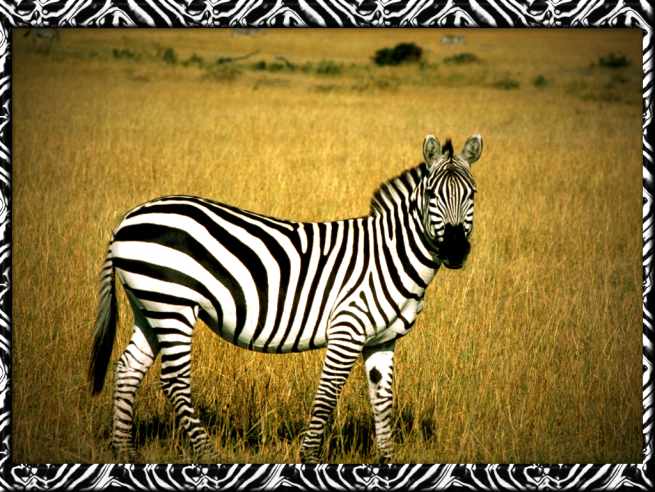
A certain event that really stopped me in my proverbial tracks as I read was the death of the zebra that lived (albeit temporarily) on the tarpaulin. I suppose I was first drawn to this story because of my love for zebras. I was fortunate enough to take a safari trip to South Africa when I was 11 years old. (My little brother and I had a once in a lifetime experience when we got to take a trip to South Africa. image is author's own.) After traveling around the "bush, as they call it, for several days and viewing all kinds of incredible animals (like elephants, lions, and hyenas) up close, I decided that my favorites were the zebra and the giraffe. It was an unforgettable experience and I have ever since had a fond spot for the zebra.(This photo of an adorable zebra was taken by my father. Look how cute it is! image is author's own).

In any case, the story of the zebra’s demise is told slowly, because it happened that way. Pi hears in the dark of night the sounds of the hyena attacking the zebra but does not see what the hyena has done to the animal until the next morning when he sees that the zebra’s leg is missing. Martel writes of the zebra that, “The victim bore its suffering patiently, without showy remonstrations. A slow and constant grinding of his teeth was the only visible sign of distress,” (Life of Pi, 151). The zebra endures several more attacks by the hyena, not to mention surviving without food and in a small lifeboat with the hot sun beating down on its back, with silent grit and bravery. Pi notes that, as the attacks continue, the zebra “protested with diminishing vigor [… and] once or twice it reared its head straight up, as if appealing to heaven – the abomination of the moment was perfectly expressed,” (Life of Pi, 158). But the zebra learns, as Pi himself explains later in the book, "You can get used to anything. Isn't that what all survivors say?" (Life of Pi, 281).(Reading about the gruesome and violent death of the zebra on Pi's lifeboat was hard to imagine, not only because of the hyena's act itself but because of the majestic beauty and theoretical harmlessness inherent in any zebra. image courtesy of:http://fohn.net/zebra-pictures-facts/photos-wallpaper/grants-zebra.jpg)

What drew me to the tale of the zebra was not only the gory and terribly drawn-out details of its death but also the obvious parallels the zebra’s death has to Pi’s entire journey after the sinking of the Tsimtsum. At one point in the story, close the hyena’s final attack on the zebra Pi despairs that he “could not imagine that things could get any worse,” (Life of Pi, 159). Such a statement is one Pi undoubtedly meant not only for the zebra’s predicament, but also for his own dire situation. Even though Pi does not go through the physical pain that the zebra does – unless you count the hunger pain he surely experiences – he does suffer from extreme emotional and mental duress during his days at sea, yet he bares the task nobly and without complaining. Rather, he worries mostly for his family, for the animals on his boat, and even for those who wish him harm and try to kill him. By the end of Pi’s time at sea, his own sense of defeat mirrors that of the zebra’s when, as Martel wrote, “[the zebra] was glassy-eyed and had become perfectly indifferent to the hyena’s occasional assaults,” (Life of Pi, 161). Pi writes in his diary that, “It’s no use, I will die today. I die,” (Life of Pi, 303). Both beings had reconciled themselves to the fact that they would probably die, and though that does not end up being Pi’s fate, he still faces the prospect with the same calmness as the poor zebra.

To bring the whole zebra and Pi’s stories full circle, I found a quote that explained both the zebra’s predicament and Pi’s selfless attitude when he endures the same type of pain. “I have not forgotten that poor zebra and what it went through,” he noted, “Not a prayer goes by that I don’t think of it,” (Life of Pi, 151). Suffice it to say, I was thoroughly humbled and stunned by Pi’s bravery and selflessness in these scenes and in this whole book. I could only hope to exhibit half the qualities Pi does were I to ever be placed in such a situation.(One of the most admirable qualities Pi exudes in this novel is bravery, especially in the way he refuses to feel sorry for himself or complain when facing the unknown and possible death. image courtesy of:http://philosophyinatimeoferror.files.wordpress.com/2009/10/633499562001283230-bravery.jpg).

Wednesday, February 3, 2010

Poetry and God

Lately, I’ve found myself reading far too much into things. This is great for analyzing poems, not so great for wondering what the slight eye-twitch my roommate exhibited this morning when I asked her where my pillow went means. See, I get into phases really easily. My mom used to worry that I had some mild form of obsessive compulsive disorder as a younger child because whenever I would read a book or see a movie about a particular person or thing that interested me I would continue to research that subject until it was almost entirely exhausted, I would become so obsessed with something that I had to squeeze every bit of juice from it before I let it pass into the recesses of my mind. I am still that way, you all know that by now. One of my longest obsessions has been with swimming, others have been involving television, photography, architecture, writing, the state of California, soy sauce, and much more. Now, when I say obsession, I do mean it in the typical can’t-get-enough-of-something way, but I also mean that when I become interested (or, obsessed, if you prefer) with something, I tend to start seeing it everywhere – in the books I read, in the dreams I have – I could be writing a paper on macaroni and cheese and could probably find a way to talk about my favorite building (architecturally speaking) in downtown Dallas. You’ve all seen me do this in these World Lit DBE’s with television. Though my mom worries about me (what else is new!), I think that this tendency in me, while perhaps a bit manic, is something that is a benefit to me, rather than a detriment. My tendency to exhaust certain subjects has made me curious, for, when I’m researching one thing I usually stumble onto another that I find to be intriguing, and the cycle continues from there.

You’re probably wondering, ‘what on earth does this have to do with the poems we’re supposed to analyze?! Has Spin completely forgotten what it means to ‘hammer into unity’?!” Fear not, I do have a point to make. What I am leading into is that one of my “obsessions”, if you will, as of about my sophomore year of high school is religious symbolism. I have always been interested in exploring other religions – I myself am a self-proclaimed Christian, and I feel that I owe it to myself, my religion, and other religions to learn about and explore other faiths in this world. Truth be told, I find the entire concept of religion, of God, of destiny, of the idea that there could be a master-plan out there in this world for us to be utterly fascinating. As a result, I have become obsessed, as I stated above, with finding religion in everything – aka searching for religious symbolism. I find this in books, in television, in a casual conversation with a friend – and I love when I do. Which is why, after this long introduction, I have to say that I was incredibly excited when I read all of the poems and short stories written by Blake, Harrigan, and Hopkins. The religious undertones almost cannot be called undertones because they are so blatant, and though I am sure to not understand many of the religious references, I am having fun studying them now and hopefully continuing to study them.

The poem that resonated with me the most was, ironically, the most confusing for me to understand at anything deeper than face value. Hopkins, “The Windhover” is an obvious poem about the flight of a majestic bird through the air. However, several words in this short piece stood out to me. Words like: "striding", "rein" (though spelled differently from reign, I got the sense that it was an intended use of the same-sounding word), "ecstasy", "valour" – these words stirred in me the notion of something majestic and powerful – more so than simply a windhover would be (Hopkins, "The Windhover", 159). I zeroed in on a particular word after reading the line, “Times told lovelier, more dangerous, Oh my chevalier!” and decided to look up the word “chevalier” (Hopkins, "The Windhover", 159). I found it to literally mean, “horseman” or “knight”. It all made sense. My own interpretation of this poem was that it symbolizes the ride of the four horsemen in the apocalypse, described at detail in the Bible’s book of Revelations, riding effortlessly through the earth and bringing those who Christ has chosen with them. The final phrases of the poem, most especially “Fall, gall themselves, and gash gold-vermillion” seemed to me a description of some epic event wherein violence (gash) leads to beauty and light (gold-vermillion) (Hopkins, "The Windhover", 159). The entire poem had an apocalyptic feel to me, but not in a terrifying or doomsday way that many works of writing dealing with a similar subject do. Rather, this piece of work felt joyous, excited at the prospect of whatever event it was symbolizing. (In this poem, what I believed to be the approaching four horsemen of the apocalypse, as shown in art form above, didn't seem so frightening to me. image courtesy of:http://steynian.files.wordpress.com/2009/06/four-horsemen-mikh-l.jpg)

Blake's two poems were easiest for me to read because they were rather straightforward and pleasant to think about. Especially his, “The Lamb” reminded me of a poem or a story that would have been typically read to me in Sunday School at church as a child. It is a poem about, to the best of my knowledge, reminding us of who Christ is and explaining that we are all made equal in the eyes of God. The interchanging words of “child” and “lamb” provided in my eyes this sense of equality I spoke of earlier and it seemed to me a purpose of the poem was to provide a rosy image of a loving, caring, all-protecting God who we should be grateful for.(What can be more loving and comforting than the image of a little lamb? image courtesy of:http://static.open.salon.com/files/lamb1234553042.jpg)

Blake’s “The Tyger” was a different story. Though just as short and intriguing as his other work, this poem showcases more of a – I don’t want to say sinister but perhaps ‘imperfect’ side of life and of this world. Where “The Lamb” portrayed a world of peace and love, this poem showcases the ugly side of humanity with phrases like, “What the hammer? What the chain? In what furnace was thy brain?” (Blake, "The Tiger", 146). There is certainly an acknowledgement in this poem that God not only created the lamb, but also the – some would say – evil tiger. How I reconcile this within myself and my own religion, I am not yet sure. I have to say, my favorite line of any poem I read this evening came from this piece of work. Though I am not sure what it means, reading it honestly sends chills down my spine: “What immortal hand or eye dare frame thy fearful symmetry? (Blake, "The Tiger", 146).

Finally, I read Harrigan’s “The Tiger is God” and, while I was not disappointed with the story, which kept me completely on the edge of my seat the entire time even though I knew what happened from the very first page, I cannot say that I was struck over the head with religious symbolism like I was when reading the above poems. More, I felt that this was a story of a ferocious animal who was “surprised, frightened, and reacted instinctively,” (Harrigan, “The Tiger is God”, 154). This story did, as I’m sure with many of my classmates, recall images of the poem “The Tyger” and even fleshed out what I believe Blake was trying to say with his work. There are two sides to humanity, two sides to the world, and there is also a significant grey area between the two in which many humans and creatures operate. Depending on who you ask, God designed this, God allows this, or God is a made-up explanation for all of this. This story addresses that, in a way.

Though in different ways, each of these works talks about God and the varying forms He takes on - not to mention the different ways that we as humans see Him. I look forward to researching these works and others by these authors more in the future.

Tuesday, February 2, 2010

P3 Sympathetic Imagination: O.J.

“OJ, come inside now!” I hear my human-mom call through the screen door. I have spent the afternoon hunting squirrels. I haven’t had much success, but boy is it fun to scare one of those little devils up a tree in fear. I don’t really want to go inside yet – I haven’t had time for my dirt bath yet, but I can tell by the tone of human-mom’s voice that it’s almost time for dinner and I definitely don’t want to miss dinner. That’s one of the best parts of my day. Well, I also really love when I get to climb on the countertop and watch the water run out of the faucet when my human-dad shaves in the mornings.(Oh, and sitting on things people are working on, like computers or puzzles, just to get my human-family's attention - that's fun too. Author's own image.) But I think my truly favorite time of the day is 2:30 AM; that’s when I get to hop up in bed between human-mom and human-dad. If I try really hard I can usually get them to wake up and request a rub down and maybe, if I’m lucky, a quick game of “chase the shadow” with my human-mom’s finger. Human-mom always tells me I act like a “dog in cat’s clothing,” I guess she means because I like to go on walks with my human-family and I like humans more than the average cat. Which is weird, considering my past experiences with humans. I don’t like to look back much, my human-sister has a poster in her room with a quote on it that says “Everything happens for a reason” and I believe it too; there’s no point in wasting my life complaining about the past. But sometimes, I find myself remembering how my life used to be. After all, I wasn’t always this happy…

I also wasn’t always a “stray” like my human-family thinks. I was born in a house with a family living in it - my real-mom’s owners. I don’t remember much about my earliest days in that house after being born, only that my mom licked me a lot, I nursed constantly, and that it was always really cold. I don’t remember much about my real-mom either, come to think of it. I remember the way she smelled – like comfort and love and linoleum floor. And I remember the look of terror in her eyes when the yelling would start; her owner drunk and angry, throwing bottles at his wife and screaming all kinds of horrible things at her. Even at a couple of weeks old, I understood what those moods of my owner meant. My real-mom would curl up around me when the fights started because the house was too small for her to find a place to hide and because she didn’t want me or my brothers and sisters to be exposed to that violence. We were so young.

I do remember the day we left that house, because it was raining and I had never seen rain before. I would see a lot of it in the next couple of days, unfortunately. I remember getting picked up and tossed into a crate along with my other siblings and then feeling the bumps under our feet – we were in the back of a truck. Something had happened with my real-mom’s owner and his wife, something to make them not want us anymore. I was too young to understand much of what was happening but I wailed anyway along with my brothers and sisters because that’s what our real-mom was doing and we copied everything she did; we weren’t yet real cats, we were imposters, pretending we knew about life and the bad things that sometimes accompany it.

I remember the bumps under our feet stopping, remembering feeling the faux-calming purr of the engine shut off abruptly. My real-mom tensed; we were here. Wherever here was, that is. The world spun for a moment as the owner picked up our crate and lifted it out of the truck bed onto the wet side of the highway. For a moment I feared he would drop us all as he maneuvered over the embankment and into the forest several yards off of the road. Then suddenly the crate opened and a blast of cold wind hit me in the eyes. None of us wanted to leave that crate; somehow we all knew something terrible waited for us outside of it. The owner wasn’t having any of that, and I heard him curse under his breath as he began to shake the crate, forcing us to leave our temporary place of safety. One-by-one my siblings fell out of the shaking crate and I braced myself, waiting for my turn. I would be the last, followed only by my real-mom. But instead of falling out, I found my body suddenly squished between my real-mom’s and the back of the crate. She had switched places with me and then she meowed, loudly. The owner poked his head over the side of the crate and saw my real-mom. Realizing, I suppose, that my real-mom was too big to fall out of a crate, he set it down and waited for her to walk out. With one last look to me, she walked out. The owner, assuming she was the last of us, shut the crate. As I hid inside, I wailed as quietly as I could and watched my real-mom and siblings descend into the distance when the owner picked the crate up and tossed it over the back of his truck, the considerably lighter load no doubt causing the realization of what he had done to wash over him. He turned back to look at my real-mom and siblings all huddled together and crying openly now and paused for a second, then turned and stepped back into the truck.

I remained numb for the rest of the car ride. My entire life was shattered, everyone I was ever close to was gone and now I was stuck in the back of a crate with a man who did not want me or my family anymore. I began to recognize my surroundings – we were almost home. I braced myself for what would happen when he found me. Would he get angry? Yell at me like he did his wife? Take me back to my family? I knew my mom was trying to protect me by leaving me in the crate, but I figured out fairly quickly that my fate would be no brighter than my real-mom’s. Sure enough, as he unloaded the crate the owner saw me, shivering and tiny in the back of the box; helpless.

The next thing I knew, the motor hummed under my feet again, only the drive was shorter this time. This time, I was picked out of the crate by the owner’s strong, calloused hands and tossed to the side of the road.

“Don’t got nothing anymore. I can’t deal with this shit and I can’t take care of you. Sorry, kid,” came his voice wafting over my head and through my ears. I looked up at him one last time, my eyes pleading with everything I had to get him to pick me back up, take me home. I would do anything not to feel the way I felt – cold, terrified, alone.

That night the rain kept falling and the wind picked up around me. I cried and wailed for my real-mom and brothers, I desperately needed someone to keep me warm. I tried to walk to find shelter, but my leg was hurt from the tumble I took when the owner dropped me and walking was difficult. So I sat there by the side of the road, waiting for the rain to stop and waiting for someone to find me. The waiting was the worst part. Because with the waiting came the doubts. What if? What if my real-mom and brothers and sisters are hurt? What if we don’t find each other? What if the owner doesn’t come back? What if he does?

Three days I lay by the side of the road. Cars passed, don’t get me wrong, but it was a country road people were driving fast and I was so little. That’s what I told myself, anyhow. If anyone saw me lying there, nobody stopped. I began to think thoughts of death, something a child of any species should never have to dwell upon. I didn’t know about heaven or what it was then, I was too young, but I knew that there had to be something more out there for me than this. I tried to be a good boy, I never hurt anybody, so why was I sitting by the side of a wet road, my paws and face dirtied with the mud that splashed by from passing cars, my leg oozing, feeling so alone. Maybe it was like what my owner had said to his wife in one argument: “Nobody loves you.” The phrase echoed over and over again in my head and I cried some more.

On the evening of the third day, just as the sun began to set, my human-family found me. I watched as the car approached, slower than the other cars; almost as if the people inside it knew something important was waiting for them up the hill. I watched it go by me and my heart sank. Just as I lowered my head, resigned to my fate now truly, I watched the red lights on the back of the car flicker on. It was coming back! They were coming back for me! The car reversed back until it was exactly parallel to me and when the door opened a teenage girl jumped out.

“Oh my gosh, look, it’s so tiny! He’s shaking, oh my gosh, oh my gosh,” she shrieked, her hands trembling as she bent down to touch me.

As soon as I felt her hands wrap around my cold fur, I knew it. I knew I had found my human-family. The next moments and days were a blur of people and noises and places and things – all new. I was dried off and given food and petted by more people than I could count but I didn’t mind. I had never been petted before in my life, and the experience was new and thrilling. Over the next few weeks, I learned the names of my human-family members and explored the house they took me to. My leg was bandaged and I got vaccinations and a brand new red collar. I got a name, O.J., named after another cat named “Oliver” my human-family said had died a recently before they found me. (I got a cool bandage for my leg, just like this one! Image Courtesy of:http://www.sharonashwood.com/Wordpress/wp-content/uploads/2009/10/pax-kitten1-276x300.jpg)

A few days after I arrived at my new home, I overheard my human-sister, the same girl who first picked me up off of the side of the road, murmur to our human-mom, “Mom, it’s like this was meant to be. Oliver dies a few weeks ago and we magically stumble across this poor kitten on the side of the road? We were supposed to raise this little guy, it’s like it was destiny or something.” They didn’t think I understood, but I could. They didn’t know the life I had before they found me, but I did. They didn’t know that I had never felt like anything but a burden to humans until they found me. I had found happiness, I had found love, I had found compassion in the arms of a family who didn’t think twice about opening up their lives to me. And I haven’t looked back since.

Word count without picture captions: 1,926.