Tuesday, December 8, 2009

Earthlings 1 DB

Nauseous, confused, helpless, angry, distraught – this is how I felt after viewing the first part of the Joaquin Phoenix-narrated and Shaun Monson-directed documentary Earthlings. I came to class naively thinking I was prepared to watch the film; even excited at the prospect of getting to watch a movie in school – as if I was back in 5th grade or something. Little did I know, my life was about to change forever.

The image that made me realize this would be no ordinary documentary, no happy-go-lucky film will probably remained burned in my memory forever: a stray dog picked up by men and tossed – without a second thought – into a trash compactor, crushed to death. ‘How,’ I asked myself, ‘can anyone be so cruel?!’ I soon watched as act after act of cruelty was performed on various animals, all for the reason of convenience or thoughtlessness or carelessness. Another image that affected me greatly was that of the tens and tens of cats and dogs placed in a gas chamber to kill them. The documentary explained that this was an extremely painful process for the animals, that it was less expensive but much more painful than the typical euthanization performed on sick or old pets. I think these scenes affected me so much because of my close relationship with animals, especially with my cat, OJ. (My kitty, OJ, is really a member of my family. I cannot imagine anything bad happening to him, it would be too hard. image: my own). I couldn't even begin thinking of what his life could have been like were he bred and raised in a “puppy mill” (do they have those for cats?) or to think of the pain he might have gone through were he destined to be a stray rather than live with us – well, it was hard to consider.

And then there were the slaughterhouses. I’ve eaten a lot of meat in my life. As an athlete, I’ve tried to stay away from fast food, but I have to admit I’ve even eaten a lot of that too. Never before had I taken the time to consider where this meat I was eating had come from, which cow had died for it, how it had been killed. To actually watch a cow’s throat be slit, to see it writhe in pain as it was “bled” and as it was hung upside down and sent down the slaughterhouse assembly line, it was almost enough to make me physically sick. ‘Do these people have no compassion?’ I again wondered to myself as I felt tears start to sting at my eyes.

Money, I realized after class, is what drives all of these industries.(Money. ugh. image courtesy of:http://reuters.socialpicks.com/photo/name/3348/money.jpg.) Companies figure out the cheapest, quickest way to kill mass amounts of animals and prepare them to become our food. That’s why they use gas chambers to kill massive amounts of dogs and cats rather than inject them painlessly and individually – money. But what can I do about this? What can any of us? Money isn’t something this country is running high on these days, and even if it was, how would I ever be able to convince anyone of paying attention to the animal cruelty when it comes to food production that I watched with my own eyes in this documentary? I left class feeling hopeless, helpless, and pained at the sight of any and all food – even vegetables! I waited – albeit not with much joy – for the next class to finish the documentary and to see if any of my questions would be answered.

Monday, November 23, 2009

Sonny

I needed this tonight. I’m tired, still recovering from being sick, ready to go home for Thanksgiving, and was really not looking forward to doing work this evening. I read Marjorie Spiegel’s The Dreaded Comparison with interest, but was not particularly moved by anything I read – not because it was not compelling, but because after a while, the vague historical references and thinly veiled pointed jabs at various trends in humanity over the years has become tiring (and also because I felt that much of what was said, at least in the first three chapters I read, I had already read about in Joan Dunayer’s “Sexist Words, Speciesist Roots” last week).

However, when I sat down to read Alice Walker’s “Am I Blue?”, all my resentment at homework and impatience with my own life melted away. Perhaps it is because the story is just that – a story, that I enjoyed it so much. It was nice, I admit, to read something fictional and, though it holds a strong message, a piece of literature that is not a strong argumentative analytical tirade against humanity or animals or whatever. But I think the real reason this tale resonated with me is because of the relationship I myself have with horses.

At age 6, I rode my first horse. His name was Sonny and he lived on my grandfather’s farm in East Texas. I will never forget the feeling of his soft hide under my right hand as I gently cradled the reins in the other, my tiny fingers drawing lines on his sweaty, brown coat. I started riding with my family around the farm – in a pen, occasionally across to a meadow, and soon I found myself riding horseback almost every weekend. My favorite times were when it was just me and Sonny, alone, cantering through a field, the wind whipping through both of our manes. (Me and Sonny!) I had never felt so close to animal in my life than in those moments, nor have I since. Then, one day, much like Walker describes in this story, I was stung by a bee while riding Sonny. Panicking, I began to yank on the reins and dig my heels into his side. Confused and scared, Sonny bucked and reared until I went flying off of him onto the gravel road beneath him. I was fine, a couple of bruises here and there, but my family and I agreed, like Walker said, “that perhaps horseback riding was not the safest sport for me,” (Course Anthology, 316). I stopped riding for several years, but never stopped visiting Sonny. Feeding him carrots and apples and just standing next to him, looking into his eyes and pressing my nose against his were the times when I honestly felt happiest and the most at peace. Unlike Walker, I have never forgotten “the depth of feeling one could see in horses’ eyes,” (Course Anthology, 316).

Upon reading about Blue’s sadness after losing his friend and mate, and reading about the look in his eyes, how it was “so full of grief, so human,” took me instantly back to my younger days with Sonny (Course Anthology, 317). ‘Of course!’ I realized, ‘all this time I’ve been trying to analyze what I think with regards to whether or not animals have the capacity to feel pain (and to what extent) and I’ve never considered Sonny!’ Though I cannot remember a time when I saw Sonny in pain necessarily, I can relate to that wonderment at gazing into his eyes and feeling like he could see right through me. Whenever I would rest my hand on his chin and press my nose to his, it felt more like I was talking to a big brother than a horse. The idea of inflicting pain on someone (yes, I said ‘someone’, a human term, sue me) I was so close to is something I cannot imagine, even now. Though Marjorie Spiegel might disapprove of even my riding Sonny, as she writes that “when we tame a horse, we actually do break her,”(Dreaded Comparison, 38) I have to disagree with this. Would Sonny have been happier in the wild? Perhaps, I cannot be sure. But his life on my grandfather’s farm was one of mostly freedom – he spent the majority of her days running, eating, and playing with the other horses on many acrage of fields. And, I’d like to think of the times when I rode him – just me and Sonny – as ones of happiness for both myself and him. Am I being naieve? Perhaps. But one thing is certain, had I never gotten the experience to ride, play with, and become close to Sonny – a “broken” horse by Spiegel’s terms – I would never be able to look down upon out and out cruelty to animals like that shown to Blue when his lover was taken from him.(Taking Blue away from his mate was cruel and unnecessary treatment, something I do not condone. image courtesy of: http://ngbc.files.wordpress.com/2008/01/horsesinsunset.jpg) Without Sonny, I would not be able to relate to animals the way that I can, nor would I be able to someday advocate for them like I hope I will.

Wednesday, November 18, 2009

An Argument About Animals

There are people in my life – in my classes, among my friends, within my family – with whom I disagree occasionally. Then there are people with whom I can’t even fathom agreeing with about everything from basic to complex issues, but who are willing to listen to an argument and perhaps even re-evaluate their own thoughts as a result. Then there are those with whom I disagree and yet don’t even bother attempting argue with, because they refuse to change their mindsets, no matter what. I find that, as I get older, I have less and less patience for these types of people. I have less patience for people who think they know everything, who don’t trust that they can learn anything from people around them. Why bother, I ask myself? Tonight I asked myself the same question. After spending a weekend with my brother recently – one of those select few who maintains the point of view that I am losing patience with – and after reading over another student’s blog this evening I wondered, why am I even bothering? Those who do not want to change their set of beliefs….they simply won’t. That’s why this discussion board entry is for me; to calm my tired brain, to allow my fingers a rest from twitching with the desire to type out the words I so desperately need to stop banging around in my head. Consider it a diary entry, a personal argument within myself, whatever. (image courtesy of: http://www.archives.gov.on.ca/english/on-line-exhibits/diaries/pics/diary_open_520.jpg)

I have less patience for those who think it is acceptable to put a species through pain for reasons outside of anything absolutely necessary to maintaining our livelihood. To put it succinctly, I have no patience for people who claim an “I’m better than [insert human or other species here]” attitude. As I read through Joan Dunayer’s “Sexist Words, Speciesist Roots,” my entire understanding of animals and humans and sadism in general broadened drastically. Until now, I had never given a second thought to derogatory terms given to women such as “cow, bitch, crow” in terms relating those words to their animal namesakes. Now I understand those words to not only be hurtful to humans, but to animals as well. Why is this? Because, “every negative image of another species helps keep that species oppressed,” (Course Anthology, 391). Take, for example, the use of the word “bitch” when describing a female pregnant dog. Dogs are usually considered to be gentile, the kinder and friendlier of many animal species, and pregnant dogs are no different – if anything there should be a level of respect in place for any species while it is carrying live within it (but that’s my semi-feminist alter-ego talking!). (What exactly is so wrong with female, pregnant dogs that their name, "bitch", has turned into such an insult? image courtesy of: http://www.muttshack.org/uploaded_images/Mom_and_Puppies_at_MuttShack_Animal_Rescue_In_New_Orleans-775630.JPG) And yet, as Dunayer notes, “Breeders, however, have always treated the female dog with contempt,” (Course Anthology, 390). Of course, people will argue against this due to the fact that certain species of animals may not have the mental capacities or, obviously, the understanding of human language to comprehend these insults. However, “this contempt legitimizes [animals’] oppression (Course Anthology, 391)” for, as feminist philosopher Stephanie Ross once explained, “oppression does not require the awareness or co-operation of its victims (Course Anthology, 391).”

Learning from Dunayer’s excerpt completely opened up a new way for me to look at things. Being a woman, I have never really been fond of using many of the derogatory “animal” words used to belittle women, but my little brother is. He has entered a phase in his teenage life (and I have to hope it is just that – a phase and nothing permanent) where he believes himself – as a human, as a man, as a white man, as an heir to a successful company, as an [insert some made-up and useless qualification here] – to be better than those around him. We have had many an argument – usually about his views of men with regards to women – that ended in tears on my part and smug contentment with the soundness of his views on his part. After watching Earthlings in class, I called home to my parents and spoke with them about possibly watching the film as a family when I came home for Thanksgiving. My mom and dad agreed, but were hesitant about showing the film to my brother, for my sake, as they believe that nothing will change his mind about his “I’m better than you” personality and don’t want to upset me when we all watch the film and my brother will possibly burst into laughter at the images before us. They’re probably right in this assumption, and because I don’t want to view my brother forever as an empathy-lacking psychopath, I will probably not force him to watch the film nor will I speak to him about my beliefs regarding animals. To be frank for a moment, I wonder sometimes how my little brother would fare if placed in an experiment like the Stanford prison experiment, and whether or not researchers would find his actions and reactions, “frightening in their implications about the danger which lurks in the darker side of human nature,” (Sadism website, 1), but I digress. Again, this is not a “giving up” thing for me; it is rather a further (possible flaw) continuation of my lack of patience with his set of views and inability to alter them.

My brother and I have broached the subject of animal cruelty before, and he explained to me an argument that I see in this class and that I see in the world around me – namely that animals are, by definition, not equal to us as humans and therefore, we have the right to treat them in whatever way we wish. We are dominant; therefore we have full privileges in every arena involving animals. My primary argument to this is: SO WHAT?! So what if animals are on a “lower level” than us in terms of intelligence, so what if they don’t share our exact chromosomes?! It has been PROVEN for a majority of animal species that they have the capacity to feel pain, just like us. So what, because my dog cannot do my calculus homework or speak my language that gives me the right to beat him to a bloody pulp and skin him alive? It is just as the famous philosopher Jeremy Bentham believed, summarized by Jacques Derrida, that “the question is not to know whether the animal can think, reason, or talk, [….] but the first and decisive question will rather be to know whether animals can suffer,”(Course Anthology, 405-406). I thought about this to a great extent when I read about derogatory words like “bitch” and how they relate to this oppression. I would imagine that my brother’s argument (if I may speculate, I’ve know the kid for 16 years so I have a little bit of an idea about how he might typically react to such a topic) would be that the word “bitch” or “cow” does not have an affect on the animal involved, due to the fact that that word is actually “true” in describing that animal. If you call a woman a cow, it is to denote that you deem her dumb. As our leader himself said in his discussion board entry this evening, Exactly. A cow is not as intelligent, does not have the same moral capacity, and does not have the same propensity to think in abstract manners, which is why this insult is so gross and debasing. But to argue that this somehow stems from a cruel lack of empathy is rather ill-founded in my opinion,” (Jose’s blog entry). I disagree with this statement. Some animals possess the human-like qualities of, “a highly developed brain, the capacity for abstract reasoning, and the ability to communicate by means of organized speech,” (Course Anthology, 393). If I am allowed to be somewhat frank for the moment, some mentally retarded people do not have these abilities. It is considered extremely inappropriate (at least in my world!) to call someone “retarded” when they are acting dumb, confused, or momentary lacking one of the typically human qualities mentioned above because it displays a cruelty and lack of empathy for those with mental retardation. Why, then, does it not display a similar lack of empathy and cruelty to a cow to call a person such? Just because it is considered true (cows = dumb, retarded people = lack everyday “human” skills) does NOT make it okay.(The message of "The Office" TV show's completely un-self aware boss Michael Scott's words shows the ignorance of those who claim that it is in no way hurtful to the animal to call a human by its name derogatorily simply because a human is acting like that animal. Just because it may seem true, or at least to apply, does not make it right. Video courtesy of:http://www.youtube.com/watch?v=NFejNW1HiKY). The only argument against this is that there is the barrier of “different species” between the two analogies, I think that is ridiculous, for all reasons mentioned above.

Maybe someday I will gain the strength, will, and knowledge required to attempt to argue with people like my brother about issues like this that I care so deeply about. Until then, I will continue to research my opinion, listen to those of others, and fight the battles that I think I have a chance of winning (or at least of having my voice go in one ear without going straight out the other) dealing with animals and my beliefs regarding them.

Monday, November 16, 2009

Anything but Silence

“Do you really believe, Mother, that poetry classes are going to close down the slaughterhouses?”

“No.”

“Then why do it? […] What is it that you want to cure humankind of?”

“John, I don’t know what I want to do. I just don’t want to sit silent.” (Elizabeth Costello, 103, 104).(image courtesy of: http://www.onenewsnow.com/uploadedImages/Media/Images/duct_tape_over_mouth.jpg)These words spoken by Elizabeth Costello in J.M. Coetzee’s novel rang incredibly true for me, even as I struggled to understand the rest of the book or even the specific points Elizabeth was trying to prove. I feel that my thoughts on the novel and especially on animal treatment discussed therein will be somewhat repetitive from what I wrote about in my last discussion board entry. Mostly, the overwhelming sensation I have is a feeling of needing to do SOMETHING. Anything, really, to support this cause of treating animals better than we do, to not let the injustices performed upon all kinds of animals daily continue.

The issues I have had the most difficulty swallowing are new in my mind – basically I’ve only just found this new passion to sort of “protect” the animals of the world since watching Earthlings in class, and I therefore don’t know all of the facets of the widespread topic of animal cruelty. However, I learned of a new one tonight when reading the novel and also Kafka’s “A Report for an Academy.” I had rarely before considered what life for an ape like that in Kafka’s story would be like – encaged, forced to perform tricks and tasks that the animal itself deems demeaning (if we are to subscribe to the theory that animals, or at least apes, have the mental capacity to perform actions that phrases like “deems demeaning” connote) all to please nothing more than human curiosity. Reads the report from the ape’s perspective, “No, I didn’t want freedom. Only a way out – to the right or left or anywhere at all. I made no other demands, even if the way out should be only an illusion,” (Course Anthology, 367). What a terrible, depressing existence.

Of course, Elizabeth feels the heat for her remarks, especially when they regard Kafka’s story and her outright comparison of treatment of animals like that ape to the Holocaust. The famous poet in Coetzee’s story, Abraham Stern fairly summed up the argument against Costello when he wrote to her, “the [comparison of jews in the Holocaust and cattle] insults the memory of the dead. It also trades on the horrors of the camp in a cheap way,” (Elizabeth Costello, 94). About this issue, I truly do not know how I feel. Like Maysie explained in her discussion board this evening, I am torn!

This is what I do know. I want to help. Tonight, in reading Kafka’s story, I learned about another issue I want to help with. I don’t think it’s right for tests and experiments to be performed on animals like the ones in Kafka’s report. I don’t think it’s right that the distinction between whether or not animals have equal intelligence as us has to be made for us to decide whether or not to cause them pain. They can feel. Period! I don’t know what I want to do: maybe I can give money, maybe I can tour a slaughterhouse, shelters, start a facebook group against animal cruelty, start a petition, walk to the capital and stand there screaming at the top of my lungs for someone to listen to me.

(Can I protest, will that help? Image courtesy of:http://dlproj.library.ucla.edu/derivatives/bennett/uclamss_686_b6_f9_2_k.jpg) I don’t even know how I feel about so many issues. But, like Elizabeth, I know this: I don’t want to sit silent.

Wednesday, November 11, 2009

Presentation is Everything

Today, still reeling from our class’ back-to-back viewings of Earthlings, I delved into E.M. Coetzee’s Elizabeth Costello with unease, unsure of what I would find there. I knew I couldn’t take any more images or descriptions like I had seen in Earthlings, couldn’t handle much more talk of animals of any kind, really. It was too painful. Needless to say, I found myself confused, albeit pleased, when I found the book to be a story of a gifted female writer (though not-so-gifted a mother, to be sure) struggling to stay relevant in a world where her ideas and books are considered old fashioned. I enjoyed very much what I have read so far and have found myself captivated by Elizabeth as a character, especially when it comes to the discrepancies between the personality she apparently puts into her books and lack thereof in the “real world.” But my enjoyment of the book is not the point I wanted to discuss in this blog entry!

Though there were many pieces of Costello’s speech about animals and animal rights that I did not understand (this is a book that I feel like I will probably want to read several times, over and over, savoring every word and rolling its main ideas around in my head until I can make some shape of the lump of clay they represent to me now – it’s a challenge), I did certainly appreciate and understand her stance on animals. She speaks almost exactly about facts and statistics regarding animals and their rights as Earthlings did, yet she (and Coetzee, if you break the fourth wall for a moment) seems to be farther ahead of her time than Earthlings.

Early on, it is established that Costello has an incredible talent for creating characters, for putting words to a page, to bringing an entire country fame with her books. However, that talent with words does not translate into oratory skills. She doesn’t think she needs to posess this talent as she tells Emmanuel Egudu, “From the beginning the novel has made a virtue of not being performed. You can’t have both live performance and cheap, hardy distribution,” (Elizabeth Costello, 50). However, I felt myself pained when reading her speech(es) regarding her beliefs on animal treatment. While her ideas might be valid and even understandable normally, under these circumstances with these people and with her rather condescending way of presenting her information, it just comes off terribly. Her son remembers a time when his wife would ask Costello how she could make a choice to be a vegetarian and she responds with the condescending, “You ask me why I refuse to eat flesh. I, for my part, am astonished that you can put in your mouth the corpse of a dead animal, swallow the juices of death wounds,” (Elizabeth Costello, 83).

I feel much the same way as Elizabeth after watching Earthlings and learning about animals via other outlets in this class like Alice’s Adventures in Wonderland. When on the phone with my parents, I try to convince them to watch Earthlings with me, try to convince my friends of the same thing. Though I do not know exactly what my stance on every minute issue of animal rights and animal cruelty is, I do know that I believe animals absolutely do NOT deserve to be caged, beaten, unnecessarily starved, and put in pain that is not warranted. Animals will always be slaughtered, that is a fact I have come to accept. But do I have to support the inhumane (pardon the irony, I cannot think of a more effective word at 11:30 at night) treatment of treatment they go through in the process? Is it really that difficult to put an animal out of pain before you kill it?Is it really too much to ask that a fox be killed before its skin is ripped from its body like wrapping paper?(image courtesy of: http://www.canadianvoiceforanimals.org/files/SkinnedFox.jpg). I also thought about attempting vegetarianism, but was met with statements from my family and peers like what is essentially summed up in Wendy Doniger’s “Reflections”, “[to] refrain from killing and eating animals is to protect [my] own soul from pollution,” (Course Anthology, 350). And it is true, for what good will it do for me to become a vegetarian other than make myself feel happy? It certainly won’t save animals from pain. (This video confirms, in part, what Doniger says when she writes that we "refrain from eating animals to protect....our bodies from social pollution" [Course Anthology, 50] courtesy of:http://www.youtube.com/watch?v=GgUgj9xZO7E). The jury is still out for me, on the issue of vegetarianism, but that is beside my point. These are the things I feel passionate about, and these are the things that, like Elizabeth, I have tried explaining to my parents and friends. However, like Ms. Costello, I have been met with disinterest, with glazed over looks and condescending nods. Sometimes, in the case of my extremely self-centered little brother, I am met with a laugh in my face and the phrase “Animals are worthless. We can do what we want with them.” As infuriated as I am, I can only imagine the frustration Elizabeth felt. Here is this woman who was given the gift of an extremely intelligent brain (or “mind” as Elizabeth would insist on calling it due to “it seeming gratuitously insulting to call it just a brain” (Elizabeth Costello, 68)) but has not harnessed the ability to convey what her mind knows through her speech. One cannot help but wonder if Egudu was giving this speech, with his winning smile and confident yet not overbearing attitude, would people respond better? In this case, presentation is everything. I found myself wishing, as I read through instances of her being challenged by everyone from her audience to her own son, that she would write a book about her feelings, one that didn’t offend others or make them uneasy the way her spoken words do. Though, I suppose that’s what E.M. Coetzee is doing, after all.

(An effective speaker can sell an audience pretty much anything. How I wished for Elizabeth to have the gift of motivation in her speaking when she spoke about such an important issue as animal cruelty! image courtesy of:http://api.ning.com/files/cjhSEEQnSUDxAZLqbh5JiDz6-NHr6nDDGMEOwixb*wQZFgNYfaE8RGxXKw0llm6ahDH*IvVdN7KxMd7jS7cSWO9S3x77FxJl/CustomizedPicture.jpg)

I am looking forward to continuing with this book and to learning more not only from Elizabeth Costello’s great mind and how she applies this to her beliefs about animals but also how I can apply not only what she does right but what she does WRONG in her presentation of her beliefs so that I can apply it to my own life.

Tuesday, November 3, 2009

11-3 Androids Discussion Leading

I want to start with a quick go-around the room of what YOU think defines being human. I know we attempted this last time - many of us didn't know and I know I still don't! But Callie brings up a great point in her DB when she says: Similarly, in our class discussion, we never clearly defined the term “human”, therefore our conversation was circular because we each had different ideas as to the meaning of the word. “Rather than connecting,” we were “like two trains passing in the night, each with only a fleeting glimpse of what is going on on the other train” (Abstractions Website). Therefore, I think it would be wise of us to try to come up with some concrete distinctions between humans and non-humans, if we can.

A lot of us had misconceptions and confusion regarding sympathy, empathy, compassion prior to reading Do Androids Dream of Electric Sheep and the Course Anthology excerpts. What did you find to be the main differences between the emotions? What did you learn about these emotions that you didn’t consider before?

Alice: What is the difference between the “specific talent(s)”(Dick, 124) of empathy, sympathy, and compassion? When I read the anthology definitions and the abstractions website, and then applied them to what I was reading in Androids, I was faced with numerous contradictions. It seems that one thing they all have in common is that they are unquantifiable – and rightly so

Helen: For instance, “compassion” is a feeling for someone’s suffering, “accompanied by a strong desire to alleviate the suffering.”[1] “Sympathy” refers to feeling the same feelings along with another person and being able to feel sorry for their problems, and “empathy” is what you feel for someone when you have experienced a similar situation.

Maysie: In comparison, I view compassion as the bright lights of the colorful stage from a children’s show rather than a gloomy and stuffy candle-lit room. In compassion their must be joy

Alice: and so the constructs of empathy, sympathy, and compassion are essentially the same, despite their differences in application – they come from a selfish desire, or perhaps even a need, to experience the emotions of others – to remind ourselves that we are among other living, feeling beings, that we are not alone in our suffering or our joy.

Katherine: Our pain is only ours to feel; it is highly and completely individualized. But the knowledge that others are there for us or are feeling pain then too or are happy can make a world of difference. Humans are social creatures, and the feeling that you are the only person who is going through something, especially if it is painful, is a highly discomforting situation. Empathy dissolves this feeling.

Thuyen: Empathy, sympathy, and compassion, as mentioned earlier, are a few humane qualities that set a civilization on the same track. Through mindful expression of these abstracted virtues, we have determined the doctrine for all that is civilized – how we should live, how we should think and feel, and what kind of person we should emulate. Empathy, sympathy, and compassion, “which are achieved through the imagination, characterize the highest moral and aesthetic exertion”

Callie: Our ultimate goal should be compassion, sympathy, and empathy because only by exhibiting these three qualities can we make a change in the world. Only through compassion, sympathy, and empathy can we leave the world a little bit better than we found it.

How did you feel about the gap between androids and humans in terms of ability and natural rights? Do you consider androids to deserve the same rights that we as humans do, or are the two simply too different to warrant equality?

Jade: When reading this novel, I continue to question the true identity of the humans in Dick’s world. What makes these human different from an android?

Lauren: I think that androids should have human rights purely for the selfish reason that I could very easily become emotionally attached to... any of them

Jose: Androids on the other hand, have no such ability and will never have such an ability. They are machines created by mankind and their emotions and behaviors have been prescribed by humans, whether intentional or not.

Karisma: We are becoming more like androids everyday! Our minds are being molded and shaped according to this giant master narrative: that the Internet is all knowing

Molly: And if androids show the beginning signs of empathy and developing understanding of others, why shouldn’t they be treated as complete humans?

Jade: To me, the remaining humans on Earth seems to evolve towards an android-like identity rather than a more human-like identity.

Sharad: I hope that androids don’t dream of electric sheep. Rather, androids ought to dream of liberation, primarily from bounty hunters like Deckard.

Did you take the android species to be a metaphor for any particular species or people in our world's present or past?

Molly: If engineers perfected their “ignoring their owner” module, an electric cat would be truly indistinguishable from the real thing. At that point, could you just call it a cat?

Molly: We treat murderers and rapists as subhuman, just as 2021ers do rogue androids. In the end, what’s the difference?

Jose: One of these situations is in the form of the difficult issue of people with certain defects that can render them virtually lifeless vegetables, completely dependent on others to survive. Is it fair to consider these people "human"?

Callie: For example, we do not think of the heartless slaughtering of animals as we sink our teeth into delicious Wendy’s hamburgers. We don’t think of the poor skinned animal as we slip into our warm fur coats.

Sharad: I believe that through the representations of androids and of humans Dick is portraying the very idea of a patent or copyright

Sharad: In my view, the androids are the slaves of humans Post-World War Terminus, and I would declare Polokov as the Nat Turner of this fictional San Francisco.

Finally, to HAMMER INTO UNITY:

Many of us changed our minds about the androids in terms of the empathy, sympathy, and compassion they deserved by books end. Did our exploration (through Course Anthology reading) of empathy, sympathy, and compassion and their distinctions help to change your mind about androids? Similarly, do you think it changed some of the human characters’ minds?

Chris: Even after Luba reveals her thoughts on mankind, I still remained uncertain about mankind’s “superiority.” The deterioration of human emotion and the hypocritical killings performed by humans on androids. Even Deckard sees the cruelty in his job. During this revelation he uncovers new truths and perspectives.

Lauren: But if we “suspend theory in order to focus on what the person of object in front of us might teach us”, we might realize that androids, despite all of their un-human flaws, may be able to teach us a higher form of empathy. I mean, it's easy to feel empathetic towards something that is like you. But with androids, I feel like we have to search more, and find that small sliver of likeness that connects us in order to be empathetic and emotional towards them.

Maysie: When Rick is “ ‘able of feeling empathy for at least specific, certain androids’”, “for Luba’s voice, in fact her career as a whole” (Dick), he is expressing sympathetic imagination. As he ponders the waste the world has experienced in its loss, he is placing himself completely in her shoes.

Emily: To empathize means “to treat something or someone with empathy” (Course Anthology 274L). The something in there is what caught my eye. So what about androids? To me, treating androids with empathy is more humane than not. However, Rick does not do this, except in the case of certain ones.

Sunday, November 1, 2009

Sympathy, Empathy, and Compassion

When I began the reading in the Course Anthology for this discussion board, I’ll admit it: I was confused. Reading the definitions for compassion, sympathy, and empathy left me with three extremely similar definitions of what seemed to me to be the same type of emotion – feeling sorry for someone. I decided to finish Dick’s Do Androids Dream of Electric Sheep to see if I could get a better understanding of these three emotions and find their basic differences through Deckard and Isidore’s experiences.

The most impactful moment in the whole book, for me, occurred when the android Pris decided to cut off a spider’s legs because, as she said, “I think it doesn’t need all those legs…maybe four are enough (Dick, 81).” The scene caused Isidore to “experience a strange sense of terror” and caused me, as the reader, to feel a similar way (Dick, 81). ‘What,’ I wondered, ‘should I categorize the emotion that Isidore (and myself) was feeling as a result of the spider’s pain?’ After re-reading the Oxford definition of sympathy, empathy, and compassion, I realized that Isidore felt sympathy for the creature; defined as “an affinity between certain things, by virtue of which they are similarly or correspondingly affected by the same influence […] attract or tend towards each other (Course Anthology, 274M)” Isidore has never had his legs cut off physically, but metaphorically speaking he has been made, in his life, to feel like the spider does when Pris mutiliates it. He is a special, a chickenhead, is treated as a nuisance upon society, and is made to feel as if he has no worth. When Pris says of the spider, “is it worth something? It’ll die anyway” before testing to cut off its legs, one can draw almost an exact parallel to the way she and her friends viewed Isidore when they first moved into the apartments and debated killing him immediately. Isidore, though he himself may only make the connection between himself and the spider subconsciously, feels sympathy for the spider because they are experiencing like circumstances.

(A song covered by Marillion about sympathy that I think captures the word's true definition along with pictures that portray how important sympathy is in OUR world, especially at this present time. video courtesy of:http://www.youtube.com/watch?v=Utsl2YeADZk&feature=related)

Another instance in the novel where these emotions play a key part is when Deckard believes himself to be Mercer. Though I was very confused as I read about Deckard climbing the hill and being hit by a rock, when he explained, “I am Wilbur Mercer; I’ve become one with him, and I’ve lost myself,” I recognized his experience to be a very literal example of empathy. We spoke a lot about what empathy is, exactly, during our last discussion of the novel in class, but we did not work so much do define what exactly it is. Again, according to the Oxford definition, empathy is “the power of projecting one’s personality into (and so fully comprehending) the object of contemplation (Course Anthology, 274L).” Deckard is an emotional wreck after killing six androids in one day, he is angry with himself for following Mercer’s allowance of those murders, and he ends up literally putting himself in Mercer’s shoes. He ends up living out the empathy box experience in real life, and experiences in turn real empathy, not empathy box-manufactured empathy. Whereas before the experience he found himself “withdrawn, removed, and separate” from the pain of Mercer as he walked up the hill, Deckard loses his abstract sense of Mercer’s journey when he himself is being pelted with rocks, living it (“Abstractions” website, 1). After the experience, he finds himself grateful for his unintentional empathy for Mercer because he realizes “I found the toad because I see through Mercer’s eyes (Dick, 100).” He also touches on the importance of empathy when he says, “Now that I’ve seen through Mercer’s eyes once, I probably won’t stop (Dick, 100). For, once we have true empathy for someone or something, it is hard to view any circumstances similar to our own without empathy. (To take a walk in someone else's shoes is a very important piece in achieving empathy. image courtesy of:http://farm1.static.flickr.com/118/250786988_936b94a8d9.jpg?v=0)

So, having identified instances of sympathy and empathy in the book – and defining their differences more clearly in my own mind – I had only to find a moment of compassion in the novel. I struggled with this definition the most, mostly because the definitions in the course anthology were extremely similar to those of sympathy. Then, I came across this defining: “the feeling when a person is moved by the suffering or distress of another, and by the desire to relieve it (Course Anthology, 274J).” That was it! Compassion, I realized, has a quality to it that the other two emotions I was analyzing did not – power. Many of my classmates may remember a day this semester when a lot had gone wrong for me. I came to class exhausted, crying, and fifteen minutes late. I knew my chances of actually walking into the classroom were slim, due to the fact that our Course Anthology clearly states that, “after six weeks have passed, the door will be closed for good when class starts […] and if anyone chooses to oen the door for someone who comes late, they will receive [points lost] (Course Anthology, 20).” However, after being initially turned away and sinking to the ground next to class in dismay at yet another thing that had gone wrong that day, I saw Katherine’s head peek around the now open door. “Spin, it’s okay, you can come in,” she said to me with a smile. I couldn’t believe it! Had she really opened the door for me, even knowing she would lose points as a result? In this instance, Katherine utilized compassion in that she felt sympathy for my experience and had the power to relieve it. (This late pass is an example of compassion a held by a teacher for a student - compassion is normally utilized in situations like the teacher-student relationship because it involves power. image courtesy of: http://parenting.leehansen.com/Printables/School/teacher-coupons.htm) In the novel, I had to look no further than the scene where Deckard decides against shooting Rachel, even after he finds that her reasons for sleeping with him were not genuine and sees that she is not with him to give help in the least. Though there are a lot of reasons to kill her, Deckard is stopped by her submission and acceptance of his shooting her and uses the power he has over her to save her life, rather than kill her.

Though I am not entirely sure what Dick’s novel was meant to prove symbolically and metaphorically in terms of applying it to our life, I did find myself extremely well-versed in the definitions of emotions like sympathy, empathy, and compassion and very in tune to my own experiences with these same emotions. I can only hope that we as a class continue to explore these themes, especially with regard to important events and issues in not-so-futuristic but equally complicated world in which we live.

Wednesday, October 28, 2009

The Beauty of Emotions

Lately, I feel like I’ve been inundated with “end of the world as we know it”-type entertainment. Okay, well, actually I guess I’ve just been obsessing over one particular “end of the world as we know it” movie. It all started last Thursday when I was reading one of my favorite magazines Entertainment Weekly. Thumbing through the pages, I came across an column regarding the upcoming Roland Emmerich film, "2012." The movie is supposedly based on the end of the world occuring in the year 2012 (as predicted thousands of years ago with some weird calendar/magic/math work) and centers around the destruction which follows. In his article, the author Mark Harris completely ripped apart the film – based on the clips he’d seen in its trailer – claiming that it “does little more than string together image after image of computer-generated cataclysm to stimulate the part of your brain that just wants to see stuff (and people) blow up real good (source: http://www.ew.com/ew/article/0,,20311060,00.html - Entertainment Weekly, Harris, 1).” Intrigued, and slightly disgusted by his references to the film’s apparently flippant take on September 11, I went to youtube to view this trailer for myself. Sure enough, after about 30 seconds I found myself in shock at the outrageous and gruesome images of St. Peter’s Basilica crumbling onto millions of people praying inside, highways and roads spontaneously exploding for no reason, and, my personal favorite, the ridiculously over the top, irony-so-subtle-it-might-as-well-be-a-baseball-bat-hitting-me-over-the-head image of a huge ship named “SS John F. Kennedy” floating over a giant wave and eventually capsizing directly on top of the white house!

(At some point, the utterly horrific images - like this of a ship crashing over the white house - devoid of any emotional context in the 2012 trailer caused me to become de-sensitized to the destruction and, frankly, bored! Image courtesy of: http://www.wildaboutmovies.com/images_7/2010_325_3.jpg)

At the time, I thought I was so disturbed by these images because they were so violent and, almost, inconceivable. However, after reading Philip K. Dick’s novel, Do Androids Dream of Electric Sheep, I can now put my finger on exactly why the trailer for this movie disturbed me so much. It’s because amidst all of the destruction and pain and death shown in that two minute trailer, there is absolutely zero semblance of emotion visible – neither on the characters faces nor in the narrator’s voice. Said Harris, “If you've seen Emmerich's earlier movies, you already know his MO: Forget about the millions of people who are dying, because what are they, in the grand scheme of things, but [ordinary people] (Harris, 1).” I don’t think that the director means to imply in his trailer or his film that if an apocalypse of such horrific proportions does actually occur, people will be emotionless about it. But the fact that he includes none of the natural emotions people would feel – such as fear, anger, desperation – in his film doesn’t make for a good film for the sole reason that it hardens the viewer to the circumstances and leaves us watching this “destructo-porn" (Harris, 1) without accessing our most important emotion – empathy.

Which brings me to my most recent “the world is almost unbelievably different from what it used to be” encounter, Dick’s novel. This book is, like "2012", set in the future. Unlike "2012", emotions are the key to this story. As I began reading it, I wasn’t sure how I could respond in a discussion board to something I could barely understand myself. Who is an android? Who is a human? Are there such things as “good” androids? How do the humans know which ones to kill? Why do they all have to have such weird and unpronounceable names?! But then I realized, it’s not so important that I understand every minute plot point, the thing I could write about was the thing I was most touched by – the inner-spirit and emotions of the characters. The thing I was struck most by when reading was how incredibly in tune the characters in the novel – humans and androids alike – are with their emotions. I guess because they are living in a world where everything that would inspire emotions like love and happiness has been destroyed, they crave it even more. This is made most evident in each human’s desire to own a real animal, not just an electronic version. When Rick Deckard sees what he believes to be a real owl, he realizes how much he needs an animal, thinking to himself that “an electric sheep was nothing – nothing at all. It had no feelings and didn’t even know that he existed (Dick, 12).” Rick wants not only to love but to feel that love in return, to feel needed by somebody. These human emotions are so basic that we ourselves take them for granted. It is unprofessional in the workplace or in public a lot of the time to make huge displays of affection or to cry uncontrollably, because society today often encourages us to repress a lot of emotions. I found this novel’s scary reality of living in a world where emotions are so scarce that people cling to them – and even make machines to allow themselves to “feel” in different ways – actually quite refreshing. (I never realized how absolutely essential emotions - especially "bad" ones like sadness, fear, anger, and desperation are to achieving empathy. Image courtesy of: http://www.sciencemuseum.org.uk/on-line/brain/images/1-1-2-1-3-0-0-0-0-0-0.jpg)

The other piece of the book I knew I wanted to write about in my blog was the mood machine. First of all, how cool is that?! The first thought that came into my mind was about how much I wanted one for myself, especially now that I’m in college. Some mornings when I wake up at 5:20 and think about the freezing pool I have to jump into, I know I could definitely use the mood machine (I’d crank it up to whatever setting makes you joyful enough to actually want to wake up at such an ungodly hour to workout….) for myself. That’s why I found myself incredulous to read Iran Deckard say to her husband when he offered to change her machine to make her happier, “Don’t touch my mood settings, I don’t want to be awake (Dick, 1).” I could not understand why anyone with the capability to use these machines would not keep themselves constantly living in a state of unadulterated contentment. That was, until I read another point made by Iran when she decides to dial her mood machine to depression: “I was in a 382 mood at the time, so I heard the emptiness but I did not feel it. I realized that it was unhealthy not to react to the absence of life (Dick, 2).” Wow, how spot-on is Iran?! Empathy is something I had honestly not really considered before reading this book, at least in the sense of pondering its origins within us as humans. But, the more I thought about it, the more I realized that Iran is right. Before I got a back injury, I always sort of took my swimming for granted. Sure, I was happy when I won races, but it took going through a very painful year physically and emotionally to allow me to really feel true joy and pride in swimming fast. You can’t experience truly “high” highs without experiencing “low” lows. D. Goleman writes in The Roots of Empathy that, “Empathy builds on self-awareness; the more open we are to our own emotions, the more skilled we will be in reading feelings (Course Anthology, 275C)”. What if Iran kept her mood machine on a “happy” level all the time, like I suggested? She would be "at a complete loss when it comes to knowing what anyone else around [her] is feeling (Course Anthology, 275C)." She wouldn’t ever feel empathy for those around her, wouldn’t ever feel ANY true emotions that make people, well, human. She is self-aware enough to recognize the importance of experiencing the whole spectrum of human emotions and this is what makes her human and not android in a world where the difference between the two is small but vastly important.

All I can say now is that I am very excited to continue reading Dick’s novel. I am excited, of course, to learn the fate of all the characters I have already come to love (and be confused by!), but mostly I’m excited to see other ways in which Dick’s future world shines a magnifying glass on our own choices, thoughts, and emotions.

(Below is the "2012" trailer I spoke of earlier. Warning: mass destruction with little emotional context. You have been warned... Trailer courtesy of: http://www.youtube.com/watch?v=Hz86TsGx3fc)

Wednesday, October 21, 2009

Lewis Carroll's Magnifying Glass on Animal Treatment

Throughout elementary school and all the way through 9th grade I was the proud “mother” of my two guinea pigs, CJ and Laser. They were brothers but looked completely different – CJ was black and white and Laser was completely white with sharp red eyes (hence the name “Laser”…). Though they mostly ate, slept, and ran around in our garage, I absolutely adored them. My little brother and I would spend hours every night cleaning their cage, cutting carrots and celery to give them as treats, and creating obstacle courses made out of “Legos” around our garage for them to run through. I’m not sure how it started, but soon after we received the guinea pigs as gifts from a friend, my family and I began a strange ritual of making up voices for the animals since, really, they didn’t seem to have much of a personality to us at that point. We gave them both heavy Brooklyn accents (again, no clue as to what was going through our minds at this point…_) and made up little conversations they could be having with each other and with us as we watched them eating hay or “popcorning” (the phrase guinea pig lovers know as describing the way they jump around when they’re excited or happy) around the garage. “Shhhpinn,” (oh yeah, they also had a lisp…) my mom would exclaim as she pretended to be CJ, “please feed me! And not any of that gross celery either, I want apples!”(Me playing some kind of game with little CJ when he was about 4 years old). After we spent more time with CJ and Laser and learned more about their individual personalities, the “voices” we made up for them seemed less necessary, yet the habit stuck.
As I read Lewis Carroll’s Alice’s Adventures in Wonderland and Through the Looking Glass and took note of the way he anthropomorphizes the creatures in both books to the point where they can talk like humans, walk like humans, and basically are humans, I was immediately reminded of what my family and I did with our guinea pigs. Why does Carroll give the animals in each story the ability to talk? Well, why did my mom choose to have Laser the guinea pig ask me about how a history test went as I fed him? The sad truth is, we as humans find it difficult to relate to animals on even a basic level. Especially, I think, is this true with pets, for we feed them, we keep their environment clean, we control much of their lifestyle. We are in a position of power over them to the point where it is difficult to put ourselves on their level and truly understand what is going on in their minds. This is not to say that we do not bond with them, as Alice does with her cat Dinah. Yet Alice’s relationship with Dinah is one of master and pet, she scolds and speaks to Dinah as though she is nothing but….well, her pet. But if animals could talk in real life, as they do in Wonderland and the Looking Glass world, it would certainly be easier to see them as having the same feelings and basic rights as we do. We begin to think, subconsciously I would hope, as Carroll suggests, “that man is infinitely more important than the lower animals.” (Course Anthology, 324). Alice, even, treats the animals she comes in contact with in both stories much the same as people in the real world do. There are instances where she talks down to the animals, as she does when she argues with the Pigeon in Wonderland, instances in which she insults them, as she does when she cruelly asks the mouse “Ou est ma chatte?” (Alice’s Adventures in Wonderland, 26). For me, the most obvious example of Alice considering these animals to be “lower” than herself, is when she chooses to kick Bill the lizard, “…to see what would happen next.” (Alice’s Adventures in Wonderland, 43). Carroll uses the narrow-minded lens through which Alice views the animals around her to make obvious that treatment of animals as if they are worth less than we as humans, or as if their feelings are any less real or important as ours, is simply wrong. I believe he emphasizes this by making these animals as human-like as possible – so we as readers could take out the descriptions of the animals, replace them with human descriptions, and read the book never knowing that Alice was kicking a talking lizard named Bill but rather kicking a talking person named Bill. Would Alice kick a man named Bill for no obvious reason? I doubt it. Carroll’s human/animal parallel is drawn effectively in this way.
While reading Carroll’s works, I began to ask myself what I thought about animal cruelty and, more importantly, what defined it. One of my guinea pigs, CJ, had to be put down after he suffered a sort of stroke. At the time, I couldn’t understand how my parents could condone the murder (as I saw it) of my little animal. Of course, I now understand the act of putting animals out of pain to be a reasonable and good practice. Jude, from Thomas Hardy’s “Jude the obscure”, felt the same way when he “could rest no longer until he had put [the rabbit] out of its pain [… and so] he struck the rabbit on the back of the neck with the side of his palm, and it stretched itself out dead.” (Course Anthology, 222).
(Since you are all familiar with my LOST obsession by now, I thought I'd share this clip in which the character Ben displays several unnecessary forms of animal cruelty [assuming you count stuffing an animal in a bag, giving it a sedative with no cause, and possible murder via fright as animal cruelty...] - quite the opposite of Jude's treatment of a rabbit in his life!) The issue of animal cruelty starts to get messy when it comes to things like hunting, eating, capturing and enclosing animals in a zoo, and more. Carroll touches most on is the eating of animals, as referenced in the scenes in which Alice is scolded for eating a piece of mutton with whom she has had a conversation of, “Mutton– Alice: Alice – Mutton.” (Through the Looking Glass, 262). Carroll chooses to capitalize the word “Mutton” in another attempt to anthropomorphize an animal in order to further his feelings that the eating of animals is a practice he does not approve of. I'd be willing to bet that, were Alice introduced to a live sheep, she wouldn't even consider eating it.
(Hmmm....before....image courtesy of http://www.recollections.nma.gov.au/shared/libraries/images/temporary_exhibitions/farmers_stories/mitchell/pet_sheep_large/files/17634/Pet-sheep_w480.jpg)
(...and after. Think I've lost my appetite. image courtesy of:http://img.chinaa2z.com/uploadpic/AboutChina/20070924/200709241114171574/2007071101394132849.jpg))

Overall, I was most touched and impressed by the way in which Carroll allows the reader to sympathize with the animals in his story by showing them cruel or, at best, hypocritical behavior on Alice’s part. Certainly the strength of his convictions have caused me to look deep into certain decisions I make regarding animals that do not usually cross my mind; decisions like eating meat, sitting idly by when my brother goes hunting, or even picking my cat up to play with while she is sleeping comfortably in the corner. I think that was one of Carroll’s goal with his Alice books – to allow us to examine our own convictions and question our own ideals, especially with respect to animals.

Monday, October 19, 2009

Learning to be a Leader With Alice

Prior to entering college his fall, I had fancied myself a leader, of sorts. I never held any huge titles of leadership, but I felt confidence in myself and my surroundings to the point that I unofficially took on the role of leadership in many settings. As a member of The Hockaday School swim team, I found myself placed in a role of leadership by my peers because of my abilities in the pool. I took this role on with pride, knowing that it was an honor to be looked up to by my teammates. In swim meets and practices, I always tried to make myself available to answer questions, help with stroke technique, or just be on the sidelines cheering my team onto victory. (Me with part of my high school team after helping lead us onto a 1st place relay finish at the state meet. By the way, recognize anybody in on the far right? 6 degrees of separation, people. It's real.)

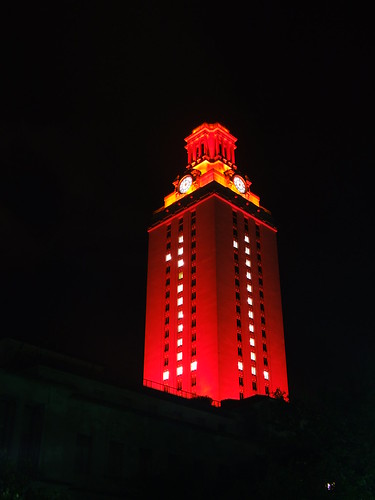
As soon as I left home, however, and joined the UT women’s swim team, all of that changed. Suddenly I was not the fastest swimmer in the pool. Not only was I the best in the pool, but I found myself unable to participate in activities like weight lifting and dryland training with the rest of my team. I am young, injured, inexperienced in the ways of college athletics, and completely out of my element. The confidence I had maintained throughout high school was replaced with a sense of inadequacy and any semblance of leadership I carried with me to school was left outside the locker room, along with the rest of my self-esteem.

(My new team, with their goal of 'turning the tower orange' has proved to be a somewhat intimidating environment to enter into. image courtesy of:http://farm4.static.flickr.com/3537/3952989980_48b60726d0.jpg)

Thusly, I found that I could thoroughly relate to Alice’s struggles of falling into a completely new world when reading Lewis Carroll’s Alice’s Adventures in Wonderland and Through the Looking Glass. Though we do not know much of her life before she falls down the rabbit hole into Wonderland, we do see a snippet of her self-confidence prior to entering her new world in her statement, “and what is the use of a book without pictures or conversations?” (Alice's Adventures in Wonderland, 11). She is assured enough in her intelligence to ask probing questions such as this one. However, as soon as she enters the world of Wonderland her confidence is shattered piece by piece by the creatures who tease and argue with her.

What Alice quickly discovered, though, is one very important key to surviving in almost any situation: she learned how to adapt. Early into her journey in her new world Carroll says of Alice, “[she] had got so much into the way of expecting nothing but out-of-the way things to happen, that it seemed quite dull and stupid for life to go on in the common way.” (Alice's Adventures in Wonderland, 19). With this skill, Alice is definitely on the right track to become a leader. As we learned from Robert Brickley, “the world’s body of knowledge doubles every five years.” (Course Anthology, 173F). I think in Wonderland, Alice experiences a form of this – though the “body of knowledge” in Wonderland is certainly skewed at best – and is able to adapt accordingly by choosing to learn from those around her rather than cling to her beliefs no matter what. For example, were she to speak with the caterpillar in Wonderland prior to falling into this new world, she might not have put up with his condescension long enough to listen to or take his advice. Yet, she decides to listen his instructions to eat different sides of the mushroom as “one side will make you grow taller, and the other side will make you grow shorter,” (Alice's Adventures in Wonderland, 53.) and is able to manipulate her size to her advantage throughout the rest of the story. She manages to maintain humble in her dealings with the creatures and proves herself to be a thoughtful and good listener, and she “seeks first to understand, then to be understood,” an attribute Covey highly admires in a leader (Course Anthology, 220). However, as her confidence grows and as she soaks up enough information about how the creatures and the entire world she is living in operates, she feels the need to speak up when something does not sit right with her. Most memorable of these instances is when she responds to the Red Queen’s instructions to “speak when you’re spoken to!” with the well-thought out and logical remark of, “But if everybody obeyed that rule […], you see nobody would ever say anything!” (Through the Looking Glass, 251).

(Though kind of an... odd band, this song by Freak Kitchen actually supports the Queen's argument to Alice of only speaking when spoken to. Alice grew confidence from listening and learning from her surroundings, disagreed with this statement, and voiced her opinions politely and logically - the way a leader does.) Video Courtesy of: http://www.youtube.com/watch?v=vc329X_8bFo

By the end of Through The Looking Glass, Alice has absorbed an incredible amount of knowledge from those she has encountered in this other world. She has exemplified many traits generally seen in leaders and feels, I believe, confident living in any world. Reading about Alice’s struggles with leadership has encouraged me to employ the methods that she and Covey utilize; techniques such as listening to and learning from the faster swimmers around me, accepting that this is the world I live in now and I have no choice but to adapt to it, and remaining humble even when I feel that I am working harder in the pool than others. Alice has taught me that there is more than just one type of leader – and that the definition of a leader in the pool doesn’t have to be the fastest swimmer. I can learn to use my position as a young team member with an injury to be a good listener to others going through the same thing. And, hopefully I can follow Alice’s path and gain confidence in my ability and myself. With such a combination as this, I hope that leadership will come naturally to me once again.