The dull bulb casting light over the classroom suddenly seemed too bright. It illuminated my already crimson cheeks and, if it was possible, made me more embarrassed and uncomfortable than I thought I could be.
“Now would be a good time for the floor to swallow me up,” I thought, as I stumbled over my words in an attempt to back peddle my way out of an already awkward situation. “Oh, no, I mean, I just meant….or, um, I just assumed….” The words spilled out of my mouth as fast as they could. “I just assumed”. It was the truth.
It had been another typical freshman year English class; all of the girls sitting cross-legged in a circle in the center of the room between desks rotated and carefully designed so as to provide the perfect back-rests for us to lean on as our conversations drifted from The Sound of Waves into the definition of purity in our modern society, and, later, into much more frivolous – yet just as enjoyable – topics of boyfriends, friend-issues, and calling teachers by their first names. Mr. Pirani had tried admirably to keep us on-topic (“Girls, what we’re discussing should at least have the pretense of relating to literature, please!”), but it had been 13 girls against one teacher and he’d finally given up and joined the conversation with us. That’s when our conversation of teachers’ surnames had turned to him.
“Ayaz? That is such a cool name. What does it mean?” my words came slightly muffled as I casually tossed another kernel of popcorn into my mouth. Casually; without thinking. In hindsight, my level of ignorance was appalling.
When his eyes dropped and his shoulders tightened, I knew I had said something wrong.
“You know, why is it that a name, if it is different, if it’s foreign, or if it’s ‘not American’,” he began, using air-quotes to accentuate his disdain, “has to mean something? I have to say I take offense at the question, just because of certain childhood memories it conjures up. It’s just Ayaz, and it doesn’t mean anything.”
I tried to listen as he explained being teased as an 8 year old for looking “different” and detailed the patronizing way he had been prodded by adults and children alike all his life with statements of “what a unique name he had”, and questions like “what does it mean?”. But even as he explained that he did not intend to embarrass me, and that he knew I “meant no harm” in my question, I found myself startlingly unable to focus on any coherent thought other than deep anger and shame for my own ignorance, as was probably evident to the now silent room, seeing as how my eyes were beginning to grow glassy and my face struggled to keep its composure. My intention, as is always the case with ignorance, no matter how good or noble it may have been, was irrelevant. The fact was simple: I had assumed that, because ‘Ayaz’ was not a typical American name, it had to have a definition, a symbolic meaning, a reason for such a strange word to be attached to my teacher. It was, as I have unfortunately come to accept, the quintessential American knee-jerk reaction to anything unfamiliar or confusing. Casually spoken, bluntly phrased, readily assumed – it was an ignorant question, one that I will always regret.
When considering Lewis Carroll’s Alice in Wonderland and Through the Looking Glass in terms of diversity, this memory of mine was the first story to come to mind. Alice makes many faux-pas throughout the story, most especially during instances when she offends the animals. The case with Alice, like with my aforementioned faux-pas, is most frequently that she is simply ignorant of the customs of the animals around her. In Through the Looking Glass, Alice sees how small the White King is and, assuming that he must need help getting up to a table because of his size, muses “Why, you’ll be hours and hours getting to the table, at that rate. I’d far better help you, hadn’t I?” (Carroll, 146). Simply because the king was tiny, Alice assumes that he cannot do as he wishes without her help. The occasion clearly flusters and infuriates the king who, “was far too much astonished to cry out, but his eyes and mouth went on getting larger and larger, and rounder and rounder,” (Carroll, 146). Again, Alice chooses to consider the king’s feelings as lesser than her own out of pure ignorance and laughs at his terror, begging him “Oh! Please don’t make such faces, my dear! You make me laugh so that I can hardly hold you!” (Carroll, 146). 
Another instance of Alice’s ignorance when it comes to diversity is seen in the case of her interactions with the mouse. Many of my classmates have cited this example in their DB’s tonight because it is arguably the most egregious case of ignorance on Alice’s part. Not only does she bring up her cat to the mouse, asking him “ou est ma chatte?” (Carroll, 26), but she offends him again later in the novel when she mistakenly thinks he is talking about his tail and insults him saying, “it is a long tail, certainly,” (Carroll, 33). The mouse consequently scolds her for not paying attention during his story and tells her, “you insult me by talking such nonsense!” (Carroll, 35). In both instances Alice gamely tries, just like I did with my teacher, to apologize and make up for hurting his feelings; “Are you – are you fond – of - of dogs?” she questions the mouse feebly after learning of his aversion to cats (Carroll, 35). Also like me, Alice’s attempts only succeed in her putting her foot further in her mouth, so to speak.
The thing I found most ironic about both of these instances is that Alice did not begin either argument with an attempt at hurting any of the creatures’ feelings. In fact, she goes out of her way – at least in the beginning of the story – to be as polite as possible. She barely even knows herself at this point, we have to remember. Like she said, “I wonder if I’ve been changed in the night? Let me think, was I the same when I woke up this morning? I almost think I can remember feeling a little different. But if I’m not the same, the next question is: who in the world am I?” (Carroll, 23). Because of this, she is extra careful, surrounded by completely new creatures in a completely new world where she doesn’t even feel like herself, to be as nice as possible to all her new friends.
However, what makes my experience different from Alice is that I’d like to think I learned from my mistake. I can’t really say the same for Alice. Just after the mouse leaves Alice and her group of animal friends in a huff, she muses to herself “I wish I had our Dinah here, I know I do!” (Carroll, 35). With birds and other small animals standing nearby, she proceeds to elaborate that, “Dinah’s our cat. And she’s such a capital one for catching mice, you can’t think! And, oh, I wish you could see her after the birds! Why, she’ll eat a little bird as soon as look at it!” (Carroll, 35). Carroll then describes a ruckus that follows, in which “some of the birds hurried off at once: one old Magpie began wrapping itself up very carefully [….] and a Canary called out in a trembling voice, to its children, ‘Come away, my dears! It’s high time you were all in bed!” (Carroll, 36).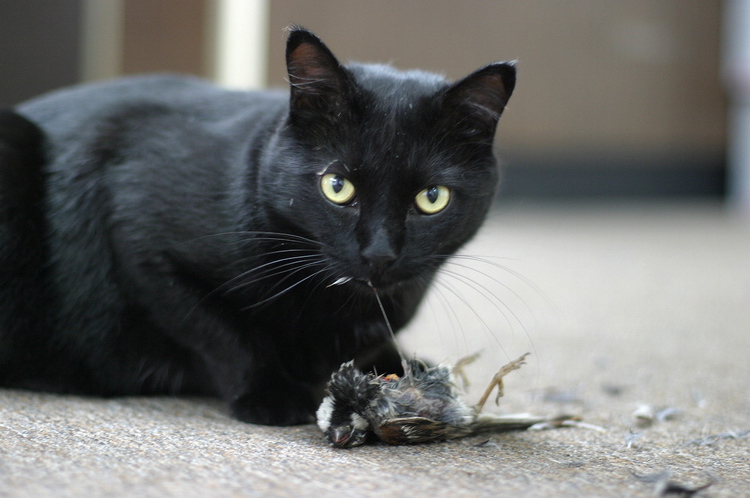

No comments:
Post a Comment