My dad claims that, to this day, he can still remember the first time I discovered how to “make believe.” I was four years old, music from the Disney movie on the television wafting over me as I lay with my father on the couch. Suddenly, my father remembers, I jumped up and started to dance around the room, imitating the princess in the animated movie. Then, I looked up at him expectantly and motioned for him to join me, “Papa, I’ll be Beauty and you be the Beast!” I exclaimed. And so it began: my love affair with “make believe”.
Since that moment, I have lived in two worlds: the world of reality and a world of fiction. “Our thoughts are always happening,” writes Ram Dass and Paul Gorman in How Can I Help, “They arise in the form of sensations, feelings, memories, anticipations, and speculations.”[1] Growing up, this was especially true for me, as my imagination was my best friend. School and friends and normal life were secondary to the adventures my imagination would take me on as a kid. I could walk into my backyard and suddenly turn into Pocahontas, sneaking around our dog kennel looking for John Smith. Staying alert during a typical 2nd grade spelling lesson was next to impossible when it was so easy to daydream about myself starring on the kids television show Zoom rather than listen to my teacher drone on. Instead of asking for flowers or unicorns or some kind of doll decoration, I instead requested Flotsam and Jetsam (the evil eels in Disney’s The Little Mermaid) to be painted with icing onto my cake for my 6th birthday, thus fulfilling my obsession with becoming the great Octopus villain of the movie – Ursula. And, of course, there was that one unfortunate incident in pre-Kindergarten that involved a fire drill, the teachers calling me by the incorrect name (Spindrift, rather than Ursula as I requested), a strong kick to my principle’s shin, and a long and terrifying wait in the office while my mom was called up to school. Suffice it to say, I was passionate about these alternate realities I created for myself.
As I entered late middle school and early high school years, the imaginary games and visions faded away, replaced by nothing, it seemed. Life just got too busy, too eventful, for me to enter these fantasy worlds. Besides, I told myself, I was far too old to do the whole imagination thing anymore. There was only one world to live in and I’d better start living my life – not one I had made up for myself. I began spending more time with my friends and family, never enjoying myself as much as I did in my imaginary world but trudging on nonetheless. That’s when I discovered Judging Amy.
One of my attempts to spend more time with my family was watching a weekly television show with my mother. That show was Judging Amy, a one-hour drama that aired every Tuesday on CBS.
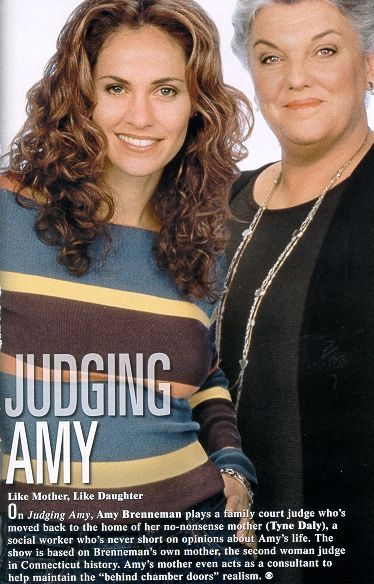
A story about three generations of women living together, the program portrayed the life of a Juvenile Judge from Connected who, as the series progressed, eventually became a highly respected candidate for the US Senate. My mom and I began watching when I was in 7th grade and, before I knew it, I was hooked. I would rush home from school to watch an episode before swim practice; wondering about what would happen to the main character, Amy, in previous seasons plagued me so much that I found a way to set up my own system of burning DVD’s from the show’s syndicated re-runs airing every night at midnight. I had found a new world to occupy – and I loved it. However, on my last day of middle school, I came home to discover that CBS had cancelled the series I had come to love. I was so irrationally upset that I couldn’t even explain to myself or others why the cancellation affected me so much. The feeling was eerily similar to my dismay at leaving behind my world of “make believe” as a kid.
What followed was my search to re-capture the feeling this tv show had ignited in me. Sure enough, time and television healed my wounds, and I found myself catapulted into the world of every single series I picked up. On any given day of the week, I could find myself enthralled in the prison escape of a genius and his convict brother on FOX’s Prison Break, cheering on the romance of two typical, ordinary, yet perfectly-made-for-each-other paper salesmen on The Office, biting my nails while a bomb scare rocked my favorite hospital drama Grey’s Anatomy, or cringing at the unapologetic corruption of a law firm in the Glenn Close series Damages.
The thing was, I wasn’t just watching television like most people. I was analyzing every move the characters made, writing down quotations from the series I found particularly poignant, daydreaming constantly throughout the summer primetime TV hiatus about how each season finale cliffhanger would be resolved come fall. I joined online message boards for each of my favorite shows and found cyber-friends just as enthralled with these made-up characters and their lives as I was. I cultivated a long-dormant love of creative writing by making up my own stories for the characters and putting them to paper in the form of scripts. (Below: A real script I was given during a trip to a Los Angeles talent agency; one that I modeled my own "scripts" after) I learned to use Windows Movie Maker by taking clips of my favorite scenes from each show, and putting them to music.
My introverted personality had always made it difficult for me to interact with lots of people or enjoy normal, everyday life like most people did. Television, I began to realize, was becoming my new creative outlet and my new version of “make believe.” When I was accused by my mom as being a spectator of life rather than a liver of it, I took a step back to analyze what my TV obsession really was. That’s when I realized – my imaginary games as a little girl almost always involved a character from a Disney movie. My current relaxation methods of listening to music, writing, or even just thinking was usually connected to television in some way. I was more comfortable imagining myself living the lives of the characters on the TV screen than I was in living my own life, just like I was more comfortable floating around my backyard pool pretending to be Ariel the mermaid than I was jumping off the diving board with my friends as a little girl. My passion had gone too far, I decided. So, as when I was in middle school, I shut myself off to the thing that made me feel the happiest. It was unhealthy, I told myself, to be so invested in the (fictitious, no less!) lives of others.
A year passed as I became a “casual viewer” of the shows I used to fanatically obsess over. I found myself more bored and less happy than ever before. I was hyper-sensitive, however, to the fact that television, as my mom reminded me, was not suitable for the role of my passion I had made it into. It was unhealthy for me and unhelpful to those around me. After all, what good does television do for the world or anyone around me other than rot children’s brains and distract them from more important, beneficial things like reading and studying? A series of random events led me to watch a show called LOST and soon enough, that question was answered.
LOST – a series centered on a group of survivors who crash-landed on a mysterious island somewhere in the Pacific Ocean - was different than anything anyone had ever seen on television before. But for me, what was different about this show wasn’t necessarily the content, but how I viewed it. My strict adherance to the unofficial rules for tv watching I had laid out for myself prohibited becoming ultra-involved with this series, and for once I did not envision myself living in the mysterious world of the characters while I watched each episode. However, something new happened. Instead of putting myself in the show mentally, I began to apply the themes of the show to my own life. LOST deals with themes of good and evil, free will vs. destiny, and makes probably the riskiest choice on primetime today by exploring religion throughout the series. This series has a way of challenging viewers to question not the ideals of the characters, but of themselves. Instead of wondering whether or not the Iraqi former-torturer will repeat his long-buried past of torturing on a fellow plane-crash survivor, we find ourselves questioning, “what would I do in a situation like that?” I still remember the first time I literally found myself stopped in my tracks by a scene in the show – during an argument by the show’s two main characters, Jack Shepherd and John Locke (oh yeah, the historical reference in the name is intentional and utilized often in LOST, another of my favorite intricacies of the series) over coincidence versus fate.(Left, Locke and Jack argue - one of my favorite scenes of LOST). I went to sleep the night after watching that scene wondering not about what terrible misfortune would befall the characters next week, but about whether I believed in fate or coincidence myself.
Professor Walter T. Davis Jr. of San Francisco Theological Seminary once said, “Under the guise of entertainment, television has made entertainment itself the natural format for the representation of all experience.”[2] I found this quote while writing a high school research paper entitled “God on the Small Screen: the Battle Between Secular Hollywood and Religious Viewers over Religion in Scripted Primetime Television.” I had begun, at that point, to realize that my passion for television had morphed from an escapist fare into what I wanted to do with my life. For me, television is indeed the format for the representation of experience. Since watching LOST, I found myself more confident, capable, and curious about the world around me. I literally felt more comfortable around people than I was prior to watching the show. As insane as it sounds, it took watching a show like LOST to get me to live my life – and enjoy it. LOST taught me by example to “think about my life story and its recurring themes, [to consider….] the events in [my] life that have inspired [my] passion,” as Robert J. lee writes.[3] I also think a part of my inner peace came not just from grappling with the all-encompassing, fundamental questions of life that LOST posed to me, but in the discovery that I could allow myself to consider television a passion. Why? Because if a good television show could help me become the person I want to be, then it can help others. I have since begun research on the TV industry (hence my high school paper regarding religion on television) – all aspects of it including writing, directing, producing, and learned about the politics of a network, ratings, advertising – everything I would need to pursue a career in my passion.
Television, as I have written before in a discussion board, aims to challenge, to inspire, and to cause us to question our own ideals and beliefs. Watching, enjoying, and living TV is truly my passion, one that I hope to use my own experiences and struggles with to create the type of quality Television that will inspire others as it did me.
[1] Ram Dass and Paul Gorman, “How Can I Help?” in Composition and Reading in World Literature, ed. Jerome Bump (Austin: Jenn’s Copy & Binding, 2009), 269.
[2] Walter T. Davis Jr., Reresa Blythe, Gary Dreibelbis, Mark Scalese, S.J., Elizabeth Winslea, Donald L. Ashburn. Watching What We Watch: Prime-Time Television Through the Lens of Faith. (Louisville: Westminster John Knox Press, 2001), 9.
[3] Lee, Robert J., “Discovering the leader in you: a guide to realizing your personal leadership potential” in Composition and Reading in World Literature, ed. Jerome Bump (Austin: Jenn’s Copy & Binding, 2009), 255.
Images/Videos:
Picture #1: http://www.bookmice.net/darkchilde/tyne/daly/amy.jpg
Video #1: http://www.youtube.com/watch?v=8vx7-QX4HXQ

No comments:
Post a Comment